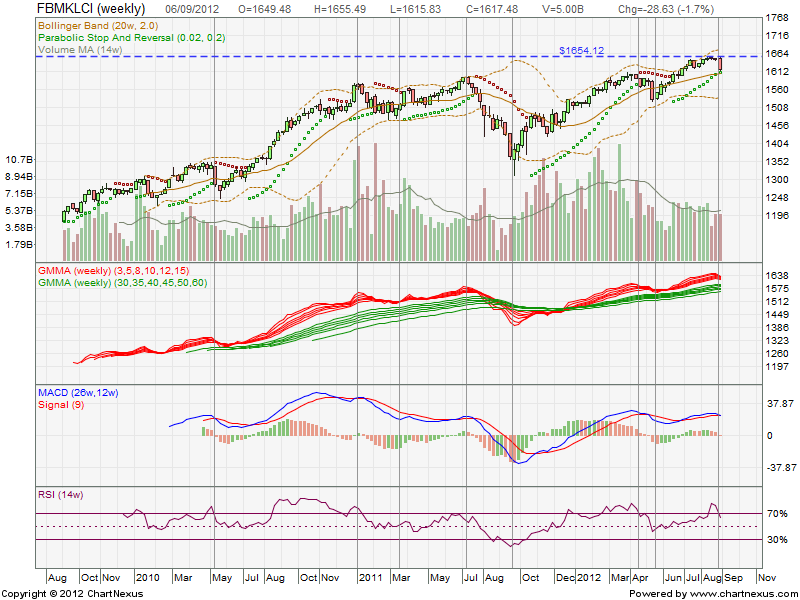
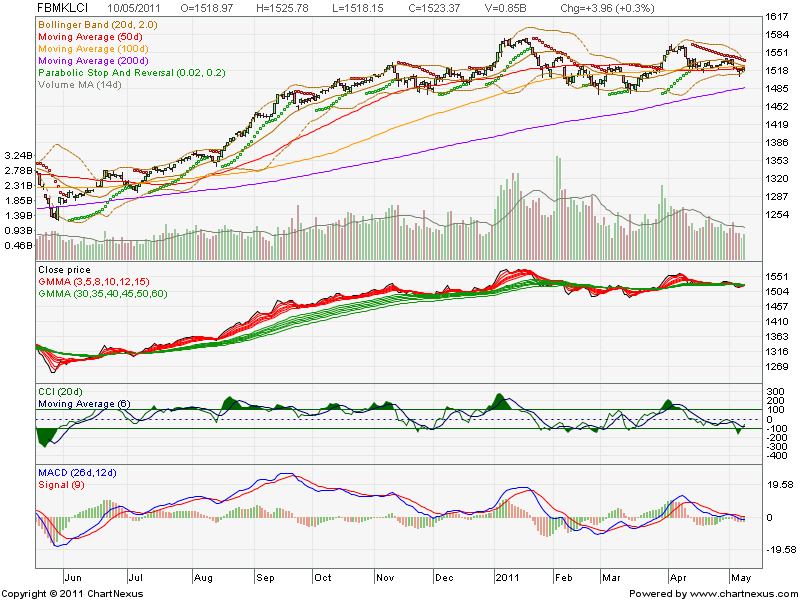
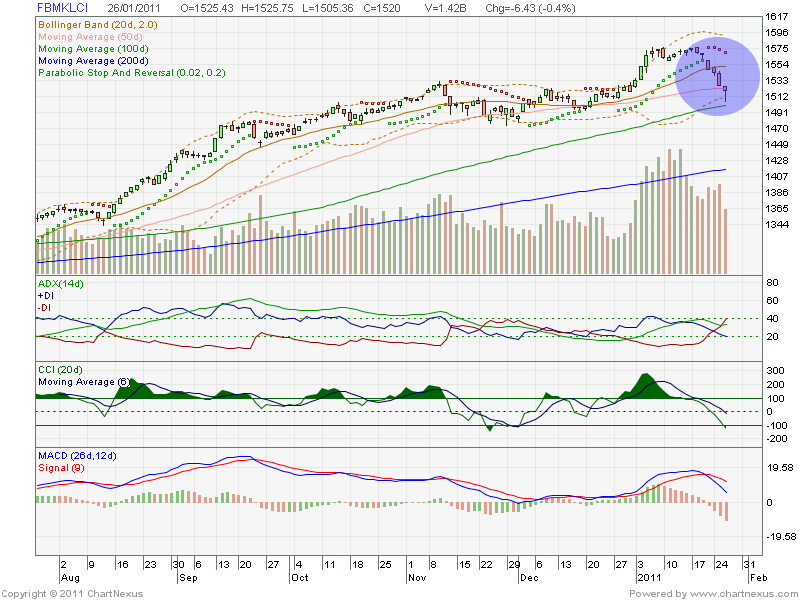
Reflections on Volume

Big volume without further upside equals distribution
Big volume without further downside equals accumulation

Volume tends to peak at turning points
Volume often precedes price movement
Volume is a relative study


Showing posts with label klci. Show all posts

Tuesday, January 22, 2013

'Market overreaction presents opportunities'

The local stock market overreaction over the upcoming 13th General Election (GE13) would present buying opportunities
for investors, says MIDF Research.

Yesterday, the FBM KLCI reacted negatively to market talk that Prime Minister Datuk Seri Najib Tun Razak may soon seek consent from the Yang di-Pertuan Agong for the dissolution of Parliament as early as this week.

If it turns out to be true, the GE13 will most probably be held by March 2013, MIDF said.

However, it said, investors may have overemphasised on the election consequence as the research house views the likeliest of results is that the status quo would remain.


"Hence, this presents an opportunity to investors with risk tolerance and who share a similar view," it said in a research note today.

Read more: Read more...

Monday, January 21, 2013

Malaysian stocks set for worst drop in 16 months on election jitters

KUALA LUMPUR (Jan 21, 2013): Malaysia's benchmark stock index fell more than 2% on Monday and appeared headed for its worst single-day drop in more than 16 months as worries over the country's upcoming election sparked selling across the board.

The FBI KLCI was down as much as 2.3% at 1,638.27 points by early afternoon, its biggest one-session loss since falling 2.5% on Sept 26, 2011, and bucking slight gains in other Southeast Asian stock markets.

A steady drip of headlines in local media about the election and speculation of a poll date late in March is fuelling the selling, said Kaladher Govindan, head of research at TA Securities, a local brokerage. The election must be called by the end of April.

Read more...

Friday, September 7, 2012

Dow Versus KLCI

Market Close Stocks End at Multi-Year Highs, Fueled by ECB

Stocks surged across the board to close at multi-year highs Thursday, propelled by a batch of upbeat economic reports and after ECB President Mario Draghi said the central bank agreed on a new bond-buying program.
 
The Dow logged its best close since December 2007, while the S&P 500 posted its best finish since January 2008.

The volatility index plunged more than 10 percent to close below 16.

Read more...


KLCI Sharply lower on panic selling

BURSA Malaysia closed sharply lower on pa-nic selling after Standard and Poor's said it may cut Malaysia's sovereign credit rating if the government did not deliver promised reforms to cut spending to reduce its fiscal deficits.


The FTSE Bursa Malaysia Kuala Lumpur Composite Index (FBM KLCI) lost 23.02 points to close at 1,617.99. It hovered between 1,613.16 and 1,635.95 throughout the day.


The downtrend was dragged by losses in heavyweights Axiata and CIMB which fell 20 sen each to RM6.02 and RM7.54 respectively.

Read more... Sharply lower on panic selling

Sunday, August 19, 2012

Gravity-defying boom

SWEET SPOT: Malaysia’s economy helped by strong growth

KUALA LUMPUR: MALAYSIA has received the thumbs up from foreign analysts and media on how it manages the economy.

Analysts, both local and foreign were stunned on Wednesday following Bank Negara’s announcement that the country was growing at a much faster pace than anticipated.

The central bank backed this, when it announced a 5.4 per cent growth in economic activities between April and June, spurred by the investments in both private and public sector spending.

For the first half of the year, the economy clocked a 5.1 per cent growth.

The strong results, at a time when most economies in the world are suffering, immediately caught the eye of the foreign media.

In recent days, Malaysia’s economy has been described to be in a “sweet spot” helped by strong growth and a subdued inflation trajectory.

Read more: Gravity-defying boom - Top News - New Straits Times

Tuesday, October 25, 2011

Tuesday, October 18, 2011

Sunday, October 9, 2011

Weekly Recap - Week ending 07-Oct-11

Failure to sustain a rebound from midday losses left stocks to roll into the red during the final hour. They still made it out with week 2% higher than where they started.

The major equity averages lacked direction this morning, even though premarket participants had cheered the September jobs report. Nonfarm payrolls grew by 103,000, up from an upwardly revised 57,000 in August. However, the upside surprise is mostly due to the end of a strike at Verizon. Excluding those workers, payrolls increased by 58,000, which is on par with the 60,000 new jobs that had been generally expected among economists polled by Briefing.com. Meanwhile, private payrolls increased by 137,000, which came on top of the upwardly revised 42,000 jobs that were added during the prior month. An increase of 83,000 had been broadly expected.

The number of people entering the workforce was roughly the same as the number of workers who found jobs in September, so the unemployment rate remained at 9.1%, which is exactly what had been expected. However, job gains were mostly part-time, resulting in an increase in underemployment that took the "real" unemployment rate up to 16.5% from 16.2% in the prior month.

Even though the payrolls report proved better-than-expected, stocks lacked leadership at the open of trade. That made it difficult for the major equity averages to extend their streak of gains to a fourth straight session. The listlessness of early trade left stocks to slide into negative territory. Selling intensified in response to news that analysts at Fitch cut their ratings on Italy and Spain. At its low, the stock market was down more than 1%.

Read more

Monday, May 23, 2011

Tuesday, May 10, 2011

Tuesday, May 3, 2011

KLCI

Saturday, April 23, 2011

Wednesday, March 16, 2011

CIMB keeps FBMKLCI target at 1,700

.
.
.
.
.

As for the local stock market, CIMB Research said timber and rubber glove sectors would be the biggest winners.

In contrast, the aviation, gaming and power sector would be the worst hit.

"We maintain our end-2011 KLCI target of 1,700 points and view selling pressure from the convergence of negative developments as a buying opportunities," it added. - Bernama

Read more: CIMB keeps FBMKLCI target at 1,700

Friday, February 11, 2011

KL stock market takes a beating

The Malaysian stock market fell by more than 2 per cent yesterday, its biggest decline since October 2008, mainly driven by heavy selling from foreign funds.

The benchmark FTSE Bursa Malaysia KLCI index closed 2.09 per cent lower at 1,503.99 points yesterday.

"This is the real McCoy. Foreign funds are flowing out of the region in a big way since last week. It's moving out from the emerging markets to the developed markets," Jupiter Securities head of research Pong Teng Siew said when contacted by Business Times yesterday.

Foreign funds sold more shares than they bought this week, based on preliminary data provided by Bursa Malaysia.

So far this week, foreign funds were net sellers of almost RM1.2 billion as they sold RM3.4 billion worth of shares while buying only RM2.23 billion.

"I think this is just a continuation of profit-taking activities by foreign funds which started early this year. Let's not forget that a lot of these markets gained substantially last year," said Chris Eng, head of research of OSK Research Sdn Bhd.

Bursa Malaysia was one of the region's top performers last year, having gained 19.3 per cent to 1,518.91. Other top performers in 2010 were the Philippines (+37 per cent), Indonesia (+46 per cent), Thailand (+40 per cent) and South Korea (+21 per cent).

Nevertheless, Malaysia still outperformed other regional bourses like Singapore (+10 per cent), Taiwan (+9.6 per cent), Hong Kong (+5 per cent).

However, most of the regional stock markets this year have taken a dip. For example, the FBM KLCI has declined by 0.98 per cent so far this year, while stock markets in Indonesia, Thailand, the Philippines, India have declined by more than 8 per cent year-to-date.

Most Asian markets closed lower yesterday, led by the Philippines, Hong Kong, Taiwan, South Korea, Thailand, Singapore and Indonesia as the bourses dropped between 2.73 per cent and 1.28 per cent.

"I think one of their main concerns and beliefs is that lower-income emerging markets as well as middle-income emerging markets may not be able to cope that well with inflationary pressures as compared to the developed markets," said Pong.

Despite the bearish sentiments, analysts are reluctant to conclude that the stock market is now on a bear run.

Read more: KL stock market takes a beating

Thursday, February 10, 2011

Newbie is 90% accurate!


10 Feb 11, 04:01 PM  newbie: let KLCI hoover around 1500 level first and then we shall see whether can it be broken
10 Feb 11, 04:01 PM newbie: as i have said earlier local funds only allocated 30% to support at 1500 level
10 Feb 11, 04:01 PM newbie: that mean they knew 1500 could be broken
10 Feb 11, 04:02 PM newbie: and another 30% funds allocation support at 1480
10 Feb 11, 04:02 PM newbie: and follow by 50% funds allocation at 1450

Taken from Bursa Chat

NB: At today's close,1504,  KLCI has retraced 50% fibo!

Wednesday, February 2, 2011

CIMB bullish on Asian equities

CIMB Group is bullish on Asian equities for the first half of 2011, given the surging liquidity which is driving equity re-ratings in this part of the world.

In a report yesterday, the group said the economic outlook for Asia has improved compared to the beginning of last year.

This is backed by the continuing quantitative easing (QE) programme in the US that should help avert the world's biggest economy from dipping into a recession again and from spiraling into a deflationary environment.

Under the QE, the Federal Reserve would print fresh money and buy bonds from US banks, which, in turn, would have more funds to lend. This was expected to spur economic activity.

CIMB (1023) said Asian economies' recent performance has shown that they have decoupled from the West. The economies have remained resilient and are registering decent growth.

The move by Asian central banks to raise interest rates throughout 2010 was also a factor.

CIMB said as a result of the widening interest rate differential favouring Asia, funds globally are flowing into the region. Notably, the MSCI World Equities index rose 3 per cent year-to-November 2010.

Asean markets such as Thailand, Indonesia, the Philippines, Malaysia and Singapore were the strong performers. The region's strong currencies also contributed to the robust performance.

CIMB said its bullish view on Asian equities in the first six months of this year was based on five factors.

The anticipation of quantitative easing activity should help drive positive sentiment in global equities, including Asia, while the widening interest rate differential in the region is attracting funds looking for higher returns.

Global equities are also cheap, with widened earnings yields between bond yields and US treasury yields currently at all-time lows, similar to the levels of the recession in 1929-1933.

CIMB said with the market anticipating further money printing, the yields are likely to stay low for longer.

Another factor contributing to the positive view is that emerging economies are recovering faster than the US, Europe and Japan.
CIMB said industrial production in emerging markets is growing faster than these developed countries, and this will support liquidity flows into the emerging markets.

It also believes that 2011 will be similar to 2006, being the second year of the present interest rate upcycle in Asia.

As long as interest rates are not too restrictive to suffocate economic and earnings growth, stock markets can rally, CIMB said.
Read more...

Monday, January 31, 2011

SapCrest, Kencana and Petrofac in JV to develop Berantai

PETALING JAYA: Sapura Crest Petroleum (SapCrest), Kencana Petroleum and Petrofac Energy Developments, a unit of London-listed Petrofac, has entered into a joint venture (JV) to develop and operate the Berantai field located 150km offshore Terengganu.

A risk service contract was signed by Petronas and the operating parties to carry out the development and production of petroleum resources from the Berantai field while a joint operating agreement was also signed between the operating parties.

The contract would be for nine years commencing Jan 31, 2011 with first gas from the project expected by the end of Dec 2011.

Separate filings by SapCrest and Kencana to the stock exchange showed that both would have a 25% stake in the joint operating agreement with Petrofac owning the remainder stake.

Under the agreement, the operating parties would provide one well-head platform with 18 wells (expected to be completed by end-2012) together with related pipeline linking it to another existing platform and the provision of a floating production, storage and off-loading vessel (FPSO).

Additionally, the operating parties would also have the right to deploy works and services to the project while a second well-head platform would be installed in a subsequent phase.

The total development cost including for the subsequent phase, to be incurred collectively by the operating parties, was estimated at this juncture at approximately US$800 million excluding the provision of the FPSO.

Read more...

Saturday, January 29, 2011

KL bourse set to consolidate further

Share prices on Bursa Malaysia is likely to dip next week with the market barometer testing the 1,500-points level as investors abstain from the market, taking a break for the Chinese New Year holidays.

The stock market will be closed on Feb 1 for the Federal Territory Day and for the Chinese New Year celebrations on Feb 3 and Feb 4. The local bourse will only trade for two days next week.

Affin Investment Bank Head of Retail Research Dr Nazri Khan said the market would continue to consolidate as investors off-load their positions due to next week's holiday-shortened trading week.

He said rumours of impending fiscal tightening by the central bank, using creative measures or non-traditonal measures such as properties, margin and reserve requirement, is expected to exert slight pressure on local market sentiment.

External factors which would continue to weigh on market sentiment next week would include rising inflationary pressure following the hike in oil and commodity prices.

"Further fiscal tightening is expected in China and India to address a property bubble and this is anticipated to impact local sentiment as both nations are Malaysia's big trading partners," Nazri told Bernama.

However, he said the undertone of the market was still intact.

For the week-just ended, sentiment remained bearish as profit-taking in heavyweight counters, despite a mild rebound on Thursday, dragged prices lower.

Read more: KL bourse set to consolidate further

Wednesday, January 26, 2011

Investors take profits ahead of CNY holidays

THE stock market's main benchmark suffered its second double-digit drop in four trading days, wiping out all of its gains so far this year.

The FTSE Bursa Malaysia KLCI fell 16.54 points to 1526.43 points. Yesterday's close was 0.46 per cent lower than the new year's first day close of 1533.42 points.

The benchmark index closed at a record of 1574.49 points last Monday.

Maybank Investment Bank Bhd's head of retail research Lee Cheng Hooi said the blue chip index could fall to as low as 1525 points.

"The market is sluggish, and some funds are getting out a bit," said Lee, adding traditionally buying interest will come back after the Chinese New Year (CNY) holidays.

The market will still have to breach the 1576 level to sustain a rise. Lee said the research house has a year end 1710 target.

Mercury Securities head of research Edmund Tham, meanwhile, believes that foreign funds are still in the market but they may have taken some profits ahead of the lunar new year.

"Some of them may have locked in gains, ahead of the long holiday period, as they will not be able to react to what's happening in the US and Europe during the period," said Tham.

Next week, the market will be closed for three trading days. On February 1, Bursa is closed for the Federal Territory public holiday, while on the 3rd and 4th, it will be closed for the Chinese New Year.

"The ringgit is strong and Malaysia is an inflation steady country unlike the Philippines and Indonesia," opined Tham to support his assessment that the exchange here is still being eyed by foreign funds.

The ringgit yesterday closed stronger against the US dollar to RM3.0525, as the currency approached a 13-year high. The ringgit reached RM3.0475 on January 14, the strongest level since October 1997.

Normally, a currency would weaken when there is an outflow of funds, while it becomes stronger when there is greater demand.

Normally, a currency would weaken when there is an outflow of funds, while it becomes stronger when there is greater demand.

Read more: Investors take profits ahead of CNY holidays


Friday, January 21, 2011

One Trading Week To CNY - FBM KLCI closes at 3wk low as funds take profit

KUALA LUMPUR: The FBM KLCI closed at a three-week low on Friday, Jan 21, the worst performance since this year as some funds took money off the table, in line with key regional markets on concerns about more monetary tightening policies by China's government.

At 5pm, the KLCI was down 19.08 points or 1.22% to 1,547.43, the lowest since Jan 3 when trading started for the year. Turnover was 1.89 billion shares valued at RM3.16 billion. Declining counters battered advancers 717 to 185 while 224 stocks were unchanged.

Most regional markets also ended in the red, with losses ranging from 0.5% to 2.16%. South Korea's Kospi skidded 1.74% to 2,069.92 -- retreating from an all-time high of 2,119.24 on Wednesday.-- as investors took profits after the main index hit record highs earlier this week, and as concerns about further Chinese monetary policy tightening weighed on shares of big exporters.

Japan's Nikkei 225 1.56% to 10,274.52, Hong Kong's Hang Seng Index 0.53% to 23,876.86 and Singapore's Straits Times Index 0.68% at 3,183.81.

Jakarta's Composite Index was the worst, down 2.16% to 3,379.54. However, China's markets managed to recover part of Thursday's losses, with the Shanghai Composite Index up 1.4% to 2,715.29.

Analysts said foreign funds were taking some money from the regional markets, which was evident from the selling of Jakarta blue chips.

At Bursa Malaysia, KL Kepong fell the most, down 52 sen to RM22.34, PPB and Kulim 30 sen each to RM17.20 and RM13.28 while Batu Kawan shed 26 sen to RM16.92 and IOI Corp six sen to Rm5.89

CIMB fell 30 sen to RM8.34, dragging the KLCI down by 5.28 points while Genting's 32 sen decline to RM11.36 pushed the index down by another 2.8 points. Other banks also fell, with Maybank down 10 sen to RM8.81 and AMMB 14 sen to RM6.76.

Petronas Chemicals fell 15 sen to RM6.20 after a news wire said was due to a downgrade at Macquarie Group Research from "Outperform" to "Neutral".

Read original here

Related Posts Plugin for WordPress, Blogger...