Reflections on Volume

Big volume without further upside equals distribution
Big volume without further downside equals accumulation

Volume tends to peak at turning points
Volume often precedes price movement
Volume is a relative study


Tuesday, October 25, 2011

Monday, October 24, 2011

Bigger network for Asia Media

Puchong: Asia Media Group Bhd, the country's largest transit-television network operator, plans to launch a terrestrial digital TV station by as early as the first quarter of next year, said its controlling stakeholder Datuk Ricky Wong Shee Kai.
"We have started testing works in Puchong and Shah Alam early this month, and have allocated as much as RM50 million in capital expenditure next year to help us with the launch in the Klang Valley," Wong told Business Times in an interview at his office.

Wong, who owns slightly more than 45 per cent of Asia Media, is also the chief executive officer of the company.
"A partial launch will be done in the first quarter, and by the second quarter, we should be in full swing," said Wong.

He said the first step in the plan to launch the terrestrial digital TV station is to launch the "out-of-home service".

"Out-of-home service means that people who use public transport such as the Rapid buses and the city's rail service will be able to watch live TV," said Wong.

Read more: Bigger network for Asia Media

Thursday, October 20, 2011

Wednesday, October 19, 2011

TimeCom as sole network provider for Scomi


KUALA LUMPUR: Scomi Group Bhd (Scomi), a global oilfield services, transport solutions and marine services provider, has appointed TIME dotcom Bhd as the sole network provider to meet its global connectivity needs across five countries.

The partnership includes the design, implementation and full management by TIME dotcom Bhd of Scomi's Private Data Network connecting Scomi's offices in India, Indonesia, United Arab Emirates, United Kingdom and Malaysia.

Read more

Tuesday, October 18, 2011

Monday, October 17, 2011

P1 to offer fibre-powered broadband in 1Q12

KUALA LUMPUR: Green Packet Bhd’s wireless broadband arm, Packet One Networks (M) Sdn Bhd (P1), will begin offering fibre optic cable-powered high-speed broadband (HSBB) and possibly IPTV services by 1Q12, having sealed a 10-year wholesale agreement with Telekom Malaysia Bhd (TM).

“Along with [the] launch early next year, we [will] also look at providing IPTV and Video on Demand (VoD),” P1 CEO Michael Lai said at the signing ceremony between P1 and TM yesterday.

The agreement gives P1 access to some 1.3 million homes connected to TM’s HSBB network, alongside leading mobile phone operators Maxis Bhd and Celcom Axiata Bhd, which had earlier signed similar wholesale agreements with TM. These services will compete with TM’s own HSBB triple-play (broadband-home voice-IPTV) offering UniFi which has 142,000 customers as at mid-August, 30% of whom are active users of the IPTV service.

P1 currently offers wireless broadband services using its WiMAX network. Lai, who declined to reveal the value of the agreement, said P1 would need very little capital expenditure for the new service as it rides on TM’s infrastructure.

“There will be some allocation for operational expenditure, [which] we will reveal in the future [when it is ascertained],” he said.

The collaboration with P1 is TM’s third agreement with a local telco since it signed the public-private partnership agreement (PPP) with the government in 2008.

Zamzamzairani: The partnership will bring enormous benefits to all end users. Under the agreement, TM is to allow any MCMC-licensed service provider access to the HSBB network that is estimated to cost RM11.3 billion over 10 years for a fee.

Read more

Thursday, October 13, 2011

Wall St. gains on euro-fund optimism, Dow up on year

NEW YORK (Reuters) - U.S. stocks jumped 1 percent on Wednesday, pushing the Dow into positive territory for the year, as the euro-zone rescue fund was set to get approval from all EU members.

Momentum buying was partly in play, analysts said. The S&P 500 has gained 13.5 percent from the intraday low hit last week on Tuesday and was on track for its largest seven-day rally since March 2009.

"It feels as though the market is experiencing the possibility of a melt-up," said Hank Smith, chief investment officer of Haverford Trust Co. in Philadelphia.

"You've got a lot of money on the sidelines that just didn't want to take the risk of being invested. That could come back in."

Slovakian lawmakers struck a deal to ratify more powers for the euro zone's rescue fund, known as the EFSF, effectively ending a crisis that threatens the euro's survival and which has weighed on stocks and other risky assets for months.

Slovakia is the last country in the 17-member currency zone left to approve the revamped EFSF.

Bank shares led the advance again, with the KBW Bank Index (Philadelphia:^BKX) shot up 4.1 percent. Citigroup (NYSE:C) gained 6.2 percent to $29.54.

The Dow Jones industrial average (DJI:^DJI) was up 159.92 points, or 1.40 percent, at 11,576.22. The Standard & Poor's 500 Index (SNP:^GSPC) was up 18.51 points, or 1.55 percent, at 1,214.05. The Nasdaq Composite Index (Nasdaq:^IXIC) was up 31.46 points, or 1.22 percent, at 2,614.49.

The S&P 500 traded above 1,200 for the first time in three weeks, taking the benchmark near the upper end of a range it has been stuck at since early August.

If the index is able to stay above resistance at 1,215, that would be seen as a bullish signal, analysts said.

Among earnings, PepsiCo Inc (NYSE:PEP) rose 3.7 percent to $63.19 after it reported slightly better-than-expected earnings and affirmed its full-year target. But Alcoa Inc (NYSE:AA) fell 2.5 percent to $10.04 and ranked as one of the biggest drags on the Dow, a day after reporting results.

(Reporting by Caroline Valetkevitch; Additional reporting by Rodrigo Campos; Editing by Jan Paschal)

Read more
Note: Downward trend channel broken upwards!!

Tuesday, October 11, 2011

Stocks End Near Session Highs, Dow Soars 300

Stocks surged in the final minutes of trading to close at session highs Monday, led by banks, amid optimism that France and Germany's pledge would help resolve the euro zone debt crisis and rescue the region's struggling financials.

The Dow Jones Industrial Average logged its best five-day point gain since Dec. 2008, led by BofA [BAC 6.28 0.38 (+6.44%) ] and JPMorgan [JPM 32.30 1.60 (+5.21%) ]. The Dow has rallied over 1,000 points from last Tuesday's intraday low of 10404.49.

The S&P 500 and the Nasdaq also ended sharply higher. Both major indexes are on pace for their best month this year. The CBOE Volatility Index, widely considered the best gauge of fear in the market, traded below 34.

All 10 S&P sectors finished firmly in the black, led by banks and energy.

Over the weekend, German Chancellor Angela Merkel and French President Nicolas Sarkozy promised to present a plan before a G20 summit early next month to shore up euro zone banks, settle the Greek debt crisis and help growth in Europe.

“The optimism is amazing to me—I don’t think any market participant is saying things are fixed in Europe, but what they’re hoping is that by the time Europe starts to resurface again in a few months from now, there will be traction in our economy that will be enough of a positive to wipe out the negative there,” Jim Iuorio of TJM Institutional Services told CNBC.

Read more

Monday, October 10, 2011

Chart Watchers See Upbeat Turn

In recent years, they have sounded the alarm over everything from "death crosses" to "Hindenburg omens," warning of a dire future for the stock market.

Now, several of Wall Street's technical analysts—the stock-market geeks who scour charts for patterns and clues to future market moves—have some good news for the bulls.

They say trading in the past few days suggests the U.S. market may have reached a bottom early last week, and that stocks are destined to move higher.

They point to the moves on Tuesday in particular, when major stock indexes were lower for much of the day before ...

Read more

Week Ahead: U.S. corporate earnings to be weak, says analyst

Sunday, October 9, 2011

Weekly Recap - Week ending 07-Oct-11

Failure to sustain a rebound from midday losses left stocks to roll into the red during the final hour. They still made it out with week 2% higher than where they started.

The major equity averages lacked direction this morning, even though premarket participants had cheered the September jobs report. Nonfarm payrolls grew by 103,000, up from an upwardly revised 57,000 in August. However, the upside surprise is mostly due to the end of a strike at Verizon. Excluding those workers, payrolls increased by 58,000, which is on par with the 60,000 new jobs that had been generally expected among economists polled by Briefing.com. Meanwhile, private payrolls increased by 137,000, which came on top of the upwardly revised 42,000 jobs that were added during the prior month. An increase of 83,000 had been broadly expected.

The number of people entering the workforce was roughly the same as the number of workers who found jobs in September, so the unemployment rate remained at 9.1%, which is exactly what had been expected. However, job gains were mostly part-time, resulting in an increase in underemployment that took the "real" unemployment rate up to 16.5% from 16.2% in the prior month.

Even though the payrolls report proved better-than-expected, stocks lacked leadership at the open of trade. That made it difficult for the major equity averages to extend their streak of gains to a fourth straight session. The listlessness of early trade left stocks to slide into negative territory. Selling intensified in response to news that analysts at Fitch cut their ratings on Italy and Spain. At its low, the stock market was down more than 1%.

Read more

Friday, October 7, 2011

U.S. stocks rise on Europe and claims data

NEW YORK (MarketWatch) — U.S. stocks climbed Thursday for a third day, sending the Dow industrials back above 11,000, as Europe stepped up efforts to bolster its banks and jobless claims rose less than feared, supporting hopes for Friday’s monthly jobs report.

Read more

Wednesday, October 5, 2011

Late surge erases earlier losses on Wall Street

NEW YORK (AP) -- A late afternoon surge capped another wild day on Wall Street Tuesday and prevented the S&P 500 stock index from entering a bear market. Stocks jumped on reports that European officials were working to prop up the region's struggling banks.

The Dow Jones industrial average was down nearly 200 points with 40 minutes of trading left. It closed up 153.

Indexes opened sharply lower as traders worried that the government of Greece could be closer to defaulting on its debt. They pared their losses at midday after Federal Reserve Chairman Ben Bernanke told a Congressional panel that the central bank could take more steps to stimulate the economy, then slumped again in the afternoon.

At 3:25 p.m., the market began rising quickly after news outlets reported that European financial ministers were working on a way to coordinate their efforts to support European banks, as they did during the financial crisis in 2008. Worries that European and perhaps U.S. banks could get hammered by a Greek default have been a major concern among investors.

Read more

Sunday, October 2, 2011

Thursday, September 29, 2011

Share buybacks point to opportunities

BOSTON (MarketWatch) — To many investors, it’s a bear market, a wasteland with few if any opportunities — even on a global scale. From high points earlier this year, Japanese markets are down 21%, Germany has dropped 33% and France has declined by 34%. And the U.S. and U.K. markets, down 17 or so percent, from peaks earlier this year, aren’t far behind.

Yet, at times like these, there’s always a bargain to be found. Like those who search for truffles, you just need to know where to look.

Read more

Saturday, September 24, 2011

Thursday, September 22, 2011

Stocks End Sharply Lower After Fed Decision

Stocks closed near session lows after selling off sharply in the final hour Wednesday as investors were cautious over the Fed's grim outlook, even as it proposed plans to ramp up its aid to help the economy.

.
.
.

The Fed announced it would launch a new $400 billion program in a move to rebalance its $2.87 trillion portfolio—a version of the widely expected Operation Twist—by selling shorter-term notes and using those funds to purchase longer-dated Treasurys.

Read more


The men who crashed the world

Tuesday, September 20, 2011

America's debt woe is worse than Greece's

Boston, Massachussetts (CNN) -- Our government is utterly broke. There are signs everywhere one looks. Social Security can no longer afford to send us our annual benefit statements. The House can no longer afford its congressional pages. The Pentagon can no longer afford the pension and health care benefits of retired service members. NASA is no longer planning a manned mission to Mars.

We're broke for a reason. We've spent six decades accumulating a huge official debt (U.S. Treasury bills and bonds) and vastly larger unofficial debts to pay for Social Security, Medicare, and Medicaid benefits to today's and tomorrow's 100 million-plus retirees.

The government's total indebtedness -- its fiscal gap -- now stands at $211 trillion, by my arithmetic. The fiscal gap is the difference, measured in present value, between all projected future spending obligations -- including our huge defense expenditures and massive entitlement programs, as well as making interest and principal payments on the official debt -- and all projected future taxes.

The data underlying this figure come straight from the horse's mouth -- the Congressional Budget Office. The CBO's June 22 Alternative Fiscal Scenario presents nothing less than a Greek tragedy. It's actually worse than the Greek tragedy now playing in Athens. Our fiscal gap is 14 times our GDP. Greece's fiscal gap is 12 times its GDP, according to Professor Bernd Raffelhüschen of the University of Freiburg.

In other words, the U.S. is in worse long-term fiscal shape than Greece. The financial sharks are circling Greece because Greece is small and defenseless, but they'll soon be swimming our way.

Read more

Saturday, September 17, 2011

50-50 chance U.S. will fall back into recession

Market up for 5th day, but Europe issues linger

NEW YORK (Reuters) - Stocks rose for a fifth day on Friday on hopes Europe was on course to solve its debt problems, but investors warned of sharp reversals if real solutions failed to materialize.

Treasury Secretary Timothy Geithner urged EU finance ministers to leverage their bailout fund to better tackle the debt crisis and to start speaking with one voice, but there was no agreement on what steps to take.

"There are still a lot of open-ended issues out there, which means this situation will remain pretty fluid," said Mark Luschini, chief investment strategist at Janney Montgomery Scott in Philadelphia. "All of what we just gained in the last five trading sessions could be given back."

On Thursday stocks rallied as the world's leading central banks agreed to boost short-term dollar funding for banks, easing investor fears about the European financial system.

More

Friday, September 16, 2011

Are Investors Taking Debt Crisis in Europe Too Lightly?

Despite a long-term picture in Europe that appears to be as unsettled as ever, investors will take any bit of good news and run with it.

That's been the message from a succession of trading days in which even the whisper of resolution to the European sovereign debt problem-a conference call among policy makers, another bailout installment for Greece-sees the market go higher.

Even downbeat economic numbers, like the batch the government released Thursday, weren't enough to derail hopes that Europe won't implode and take the global economy down for the ride.

"Somehow we're back to a risk-on trade again," says David Twibell, president of Custom Portfolio Group in Englewood, Col. "The problem in Europe is, 1) very serious, and 2) there is no easy solution. If there was we would have already solved the problem. The market is being a bit pollyannaish right now."

An announcement that the European Central Bank and its global cohorts are embarking on a program aimed at providing dollars for liquidity-challenged banks served as all the catalyst the market needed to surge.

Those who trade on hope that the plan will fix the debt crisis do so at their own peril, Twibell says.

"If the market is going to be remotely rational, the upside is going to be fairly limited," he says. "We still don't know how the US economy shakes out. The situation in Europe is going to be an overhang. I don' see a lot of upside, and the downside could be substantial if we see a disorderly default in Europe."

Though the problems with European debt and the effect it will have on banks run well beyond liquidity and into actual solvency, the narrative that took hold was that central bankers were taking a proactive step to prevent another catastrophe on the scale of the fall of Lehman Brothers.

The move came on the third anniversary of Lehman's implosion and conjured up memories of the financial crisis that nearly brought down the entire global economy.

"What is the good news? That the big powers in Europe are still adamantly opposed to any kind of debt resolution?" said Walter Zimmerman, senior vice president at United-ICAP in Jersey City, N.J. "Those who don't have a vested interest in European banks look at that and say it's just delusional to think that Greece is going to get out of this without any type of debt restructuring."

The answer to the market's movement, then, could be as much technical as it is based on hopes for European stability.

More

Thursday, September 15, 2011

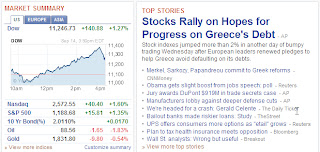
Stocks Rally on Hopes for Progress on Greece's Debt

NEW YORK (AP) -- Stock indexes jumped in another day of bumpy trading Wednesday after European leaders renewed pledges to help Greece avoid defaulting on its debts.

The Dow Jones industrial average was up 194 points, or 1.8 percent, to 11,299 at 3 p.m. It had been down as many as 112 points within an hour after the opening bell.

The leaders of Greece, France and Germany agreed in a teleconference that Greece was an "integral" part of the 17-nation bloc that uses the euro. Greece also agreed to abide by agreements to trim its debts. The statements were intended to calm fears that Greece was headed for a default on its debt or might be forced to exit the euro.

European stock indexes rose in the hours leading up to the meeting as investors hoped the talks would be productive. Germany's DAX gained 3.4 percent and France's CAC-40 1.9 percent.

The threat of a Greek default and the damage it could wreak on financial markets has had investors on edge in the past two weeks, lifting Treasurys and weighing on stocks. The yield on the 10-year Treasury note hit a record low on Monday of 1.87 percent and the S&P 500 has only risen three days this month.

Uri Landesman, president of the New York hedge fund Platinum Partners, said worries over Greece have gone too far. Landesmann thinks European countries won't let a Greek default create a larger financial crisis. "They're just not going to let them go under," he said. "That's just not happening. I think people have learned the lesson from letting Lehman Brothers fail."

German Chancellor Angela Merkel distanced herself from comments this week by her vice chancellor and others who suggested a Greek bankruptcy was possible. The finance ministers from the 17 nation-bloc that uses the euro currency will meet on Friday in Poland.

Read more

Tuesday, September 13, 2011

Stocks Could Be Running Up the 'Bear Flag,' Signaling Another Move Lower


Read more

Dow Could Crash to 3,000 in 2013: Author

The recent gyrations in global stock markets are just the beginning, says U.S.-based economist and author Harry Dent, who believes the Dow will fall below 10,000 in the near term before crashing to around 3,000 in 2013.

He pointed to the selloff during the last global financial crisis, when the Dow lost around 8,000 points in the period between October 2007 and early 2009.

Dent based his bearish predictions squarely on the changing spending habits of global consumers.

"Baby boomers around the world, and all the developed countries — Europe, North America, Australia — they have peaked in their spending cycles...they've been driving up real estates prices and stock prices and the economy for decades, and now they're going to be saving and not borrowing," Dent said.

Accentuating the problem is the deleveraging of U.S. private debt, which has doubled to $42 trillion from $20 trillion in the last eight years, according to Dent, and is now valued at three times the size of the nation’s public debt.

"That debt is deleveraging, and that's actually causing deflationary trends. It won't matter how much stimulus the government throws at the system, because baby boomers with their already huge debt burdens will not want to borrow money and spend more,” said Dent.

"In the Great Depression, that's what happened — deflation came in such a deep downturn because so much debt was deleveraging."

Read more

Stocks turn higher in final minutes


Saturday, September 10, 2011

Friday, September 9, 2011

Obama Unveils $447 Billion Jobs Plan to Congress

President Barack Obama proposed a $447 billion jobs package on Thursday to help boost the U.S. economy, challenging Congress to pass legislation made up largely of tax cuts for workers and businesses.

"It will provide a jolt to an economy that has stalled and give companies confidence that if they invest and hire there will be customers for their products and services. You should pass this jobs plan right away," Obama said.

Obama, whose 2012 re-election depends on his ability to bring down the 9.1 percent unemployment rate, proposed extending unemployment insurance at a cost of $49 billion, modernizing schools for $30 billion and investing in transportation infrastructure projects for $50 billion.

But the bulk of his proposal was made up of $240 billion in tax relief by cutting payroll taxes for employees in half next year and trimming employer payroll taxes as well.

The $447 billion is more than the $300 billion initially expected.

Read more

Wall St extends losses after Bernanke speech

Thursday, September 8, 2011

Stocks rally after Germany upholds bailout plan

NEW YORK (AP) -- U.S. stocks rallied for the first time in three days Wednesday after a German court backed the country's role in bailing out other European countries. The ruling renewed hopes that Europe will find a solution to its long-running debt problems.

The Dow Jones industrial average jumped 253 points, or 2.3 percent, to 11,392 at 2:30 p.m. EST. The Dow and other U.S. indexes fell over the previous three days on worries about Europe's debt woes and weakness in the U.S. jobs market. All 30 stocks in the Dow rose.

Read more

Bernalec and Bernalec-cb

Bursa and Bursa-ct


Wednesday, September 7, 2011

U.S. stocks drop in bleak September streak

NEW YORK (MarketWatch) — U.S. stocks tumbled for a third straight session Tuesday, marking the S&P 500’s worst September start in its five-decade history, on worries related to Europe’s debt crisis.

A rush to assets still perceived as safe sent the 10-year Treasury yield to a record low. The Swiss franc, recently a popular alternative to the euro and dollar, fell the most since the formation of the euro after the Swiss central bank capped the exchange rate.

The day’s action resulted in the roughest September start for U.S. stocks in years if not decades. Still, the close marked a recovery from session lows.

Read more

Monday, September 5, 2011

Sunday, September 4, 2011

Saturday, September 3, 2011

Stocks plunge after US hiring dries up in August

NEW YORK (AP) -- Stocks plunged Friday after a dismal report on the job market renewed fears of another recession.

No jobs were added in the U.S. last month, the government said early Friday. It was the worst report in 11 months. The unemployment rate held steady at 9.1 percent. It has been above 9 percent in all but two months since May 2009.

"It's certainly ugly," said Jeff Kleintop, chief market strategist at LPL Financial. Kleintop said the report didn't change his view that the economy was headed for a stretch of weak economic growth, not a recession.

Treasury yields fell sharply and gold jumped $48 an ounce as cash flowed into investments seen as less risky than stocks. Overseas markets followed U.S. stocks lower. They were already lower on reports that talks between Greece and international lenders over that country's debt crisis were breaking down.

The Dow Jones industrial average dropped 250 points, or 2.2 percent, to 11,240 at 3:37 p.m. EST. All 30 stocks in the Dow fell. Bank of America Corp. fell the most, 8 percent.

The Standard & Poor's 500 index fell 30, or 2.5 percent, to 1,173. The Nasdaq composite index fell 65, or 2.5 percent, to 2,480.

The losses wiped out most of this week's gains, pushing the Dow and S&P 500 down by less than 1 percent. Stock indexes rose last week for the first time since July 22.

Volume was thin ahead of the Labor Day weekend, which often makes markets take bigger jumps. When fewer traders are active in the market, large buy and sell orders can move stock prices more than they would on a typical day.

The lack of hiring in the Labor Department's closely watched jobs report surprised investors. Previously reported job addition figures for June and July were also revised lower. The average work week declined and hourly earnings fell.

Read more
Related Posts Plugin for WordPress, Blogger...