Reflections on Volume

Big volume without further upside equals distribution
Big volume without further downside equals accumulation

Volume tends to peak at turning points
Volume often precedes price movement
Volume is a relative study


Tuesday, November 2, 2010

Petronas Chemicals' big debut

By Goh Thean Eu

Petronas Chemicals Group Bhd, a Petroliam Nasional Bhd (Petronas) subsidiary, will be listed on November 26 in what will potentially be the biggest initial public offering (IPO) in Southeast Asia, valued at over RM12.5 billion.

The IPO involves 2.48 billion shares, or 31 per cent of Petronas Chemicals' enlarged share capital, according to its listing prospectus published yesterday.
The exercise includes an offer for sale of 1.78 billion shares and issuance of 700 million new shares. More than 10 per cent, or 293 million of the IPO shares, are being offered to retail investors at RM5.05 each.
The price for institutional investors is being fixed via a bookbuilding, with the bidding price starting at RM4.50, sources said.
The share sale is set to be the biggest in the region, at least in recent times. It will surpass the US$2.7 billion (RM8.4 billion) raised by Global Logistic Properties Ltd in Singapore last month and the US$3.3 billion (RM10.2 billion) raised by Maxis Bhd last year.

Petronas Chemicals expects to generate some RM3.54 billion proceeds from the 700 million new shares, the prospectus noted.

Almost two-thirds of the proceeds, or RM2.24 billion, will be used for business expansion and acquisitions in the next five years. About one-third, or RM1.2 billion, is for working capital over two years.

Petronas Chemicals' sales and profit have declined in the past two years. Its earnings eased 25.5 per cent to RM3.45 billion in the financial year ended March 31 2009, while revenue dropped 3.79 per cent to RM12.86 billion.

The following fiscal year, net profit fell 24.7 per cent to RM2.59 billion while sales slowed 1.3 per cent to RM12.2 billion.

Analysts, however, remained upbeat about response to the IPO. This was due partly to the strong interest shown in last week's listing of Malaysia Marine and Heavy Engineering Holdings Bhd, another Petronas outfit.

"I believe the IPO will generate good response from investors. First is that the company gets its gas feedstock from its parent, which may translate into better margins. This will help it to be profitable, even during bad years.

"Second is that it will be a composite index component stock. Investors just can't ignore that," said an analyst from a local brokerage, who declined to be named.

The analyst added that Petronas Chemicals' proposed dividend policy of giving half of its net profit back to shareholders would add to its appeal.

Most analysts and research heads are in a "blackout" phase currently as the investment banks they are working for are involved in the IPO. During this time, they are not allowed to issue research reports or comment on Petronas Chemicals.Signs are that the company is on the growth path again.

In the four months ended July 31 2010, its net profit jumped 59 per cent to RM938 million. Group revenue rose by almost 30 per cent to RM4.22 billion.

"It is a volatile business. You have good years and bad years. And when you are in good years, the profits are really, really good," said a research head.

Some analysts, however, were not entirely positive on the company.

"It is currently in a very tight spot. It is caught in between the supplier countries and consumer countries, whereby supplier countries like those in the Middle East and consumer countries like China are setting up their own petrochemical plants.

This has resulted in increased competition," said another analyst.

The principal adviser, managing underwriter and joint underwriter of the mega-IPO is CIMB Investment Bank Bhd, with 13 other local investment banks as joint underwriters.

The retail offering, which began yesterday, will end on November 9.

The institutional offering, which started on October 26, will end on November 12.

Price determination date and balloting will also be on November 12.

Read more: Petronas Chemicals

Monday, November 1, 2010

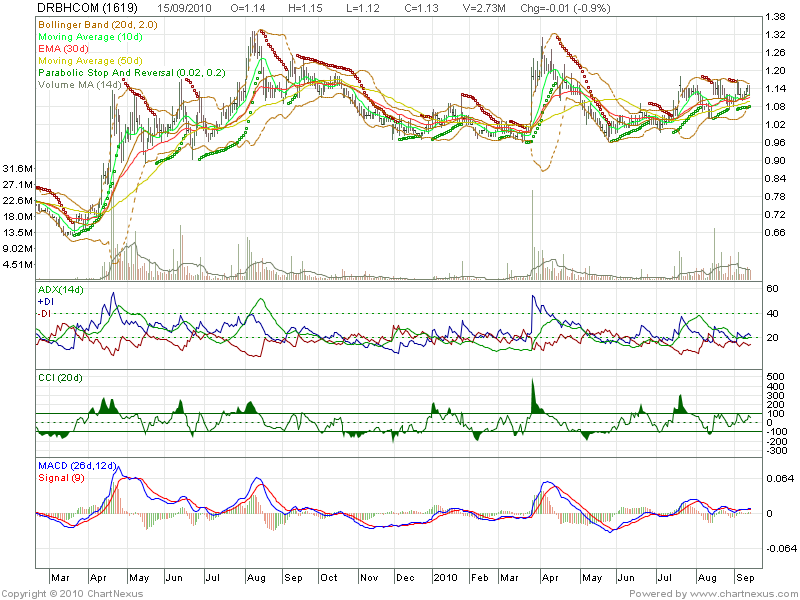
DRB-HICOM seeks revenue balance

By Shahriman Johari
DRB-HICOM Bhd (1619) plans to improve the balance of revenue contribution from its services, automotive and property businesses over the next five years as it seeks to expand.
Currently, its motor vehicle business makes up some 57 per cent of revenue, followed by its banking, insurance and power plant maintenance services at about 40 per cent.
Property makes up less than 2 per cent of revenue now, but DRB-HICOM wants to boost this to 20 per cent in five years.

"I never like to put all my eggs in one basket," group managing director Datuk Seri Mohd Khamil Jamil told reporters at a briefing in Kuala Tahan, Pahang, yesterday.

DRB-HICOM, controlled by Tan Sri Syed Mokhtar Al-Bukhary, reported net profit of RM472 million in the financial year to March 31 2010, 29 per cent down from the year before mainly because it gained almost RM600 million from an asset sale last year. Revenue hit a record of RM6.3 billion.

The group plans to launch properties with a total gross development value of RM9 billion over 10 to 15 years. This will be a mix of residential and commercial properties. It has some 607ha near Mount Austin, Johor, which will be developed into a new township. "There are still pockets of land in DRB which are very prime," Mohd Khamil said. They include a piece of land in Taman Wahyu in Jalan Tun Razak, Kuala Lumpur, and tracts of land in Shah Alam, Selangor. This month, it plans to launch Glenmarie Gardens, a high-end bungalow project.

As for its motor vehicle business, it aims to sign a definitive agreement with Europe's Volkswagen AG (VW) next month. VW had signed in August a memorandum of understanding with DRB-HICOM to produce VW cars from 2012 at the group's plant in Pekan, Pahang. "The final negotiations are going on well and the parties are finalising the terms," he said. Eventually, the deal may include the export of VW cars to Asean countries, among other things.
DRB-HICOM is also still looking for a foreign partner to buy 30 per cent of its Islamic lender, Bank Muamalat Malaysia Bhd. It holds 70 per cent of the bank currently. It was in talks with five foreign parties and one local firm, but the talks fell through amid the global financial crisis last year.
Asked about the weak performance of its stock, Mohd Khamil said it could be due to the fact that the group was too diversified. It is also classified under the industrial sector on Bursa Malaysia although services have become a big part of its business. "If shareholders understood the nature of our business, the share would definitely escalate and show their true value," Mohd Khamil said. Apart from Syed Mokhtar with 55.92 per cent, its other main shareholders are the Employees Provident Fund with 9.11 per cent and Khazanah Nasional Bhd with 5.13 per cent, according to its 2010 annual report.

Taken from here...

Saturday, October 30, 2010

SIME - Plantations on an extendable rally

Plantation sector
Upgrade to overweight: We view that there may be impetus for crude palm oil (CPO) prices to run further in coming months. The key drivers for prices are: (i) strong exports which are already up 6.4% year-to-date (YTD); (ii) weak production that is only up 1.6% YTD; (iii) upcoming festive season demand may see CPO stock levels tumble; and (iv) the soyabean market faces a tightening in supplies due to China's demand. Just to illustrate the severity of point (iv), 9MCY10 imports by China already make up some 94% of full-year 2009 imports.

For 2011, we see that CPO prices have a good potential to average at RM2,700 per tonne. It might appear low compared with current CPO prices, but let us not forget that CPO prices are volatile. We view that prices will be stronger in 4Q10/1H11, given the factors mentioned above, but then may calm down in the later part of the year as supplies of other oil seeds may recover, cooling demand for palm oil. Of course, this is assuming there are no weather shocks next year affecting palm oil or other major oil seeds.

The picture we paint appears to make for another CPO price rally, however, there are always risks we have to watch out for: (i) a strong South American crop may balance out soya market supplies; (ii) a drop-off in exports due to overstocking in countries like China; (iii) strong production of other oil seeds may reduce the need for palm oil as a replacement; and (iv) structural changes like import duties or quotas that may affect exports.

Following our series of earnings and call upgrades for the stocks under our coverage we are now formalising our 'overweight' view on the sector. We note that Sime Darby (YTD -1.2%) and IOI (YTD +6.2%) particularly have been laggards compared with the FBM KLCI (YTD +17.3%). KLK (YTD + 17.6%) and Genting Plantations (YTD +36.5%), on the other hand, have been stronger YTD. Hence, we view more upside potential for Sime Darby and IOI, citing them as the top picks for the sector. ' ECM Libra Investment Research, Oct 28.

This article appeared in The Edge Financial Daily, October 29, 2010.

Thursday, October 28, 2010

On the fast track

Several companies made presentations to the National Key Economic Area (NKEA) lab about three months ago on the Kuala Lumpur-Singapore high-speed train project, industry sources say.

Among them were YTL Corp Bhd and Hartasuma Sdn Bhd (4677), which was said to be partnering a Chinese state-owned firm.

Hartasuma, a Class "A" Bumiputera contractor, is a member of Ara Group, founded by Datuk Aisamar Kadil Mydin Syed Marikiah and Tan Sri Ravindran Menon, director and executive director of Subang SkyPark Sdn Bhd respectively.

Its track record includes repair and overhaul of passenger coaches for KTM Bhd and civil works (Kuala Kubu Baru-Tanjung Malim Halt) for the Rawang-Ipoh electrified double tracks.

Business Times understands that some of the companies have proposed to undertake the high-speed rail project for between RM8 billion and RM14 billion.
A government source said the project could be worth RM10 billion to RM12 billion and that it would take five to eight years to complete as it will cover 300km.

The source said that cost would depend on the type of technology deployed, whether it is magnetic levitation (maglev) or conventional, and how the tracks are aligned.

Maglev will cost more than conventional, but requires less maintenance, is safer and faster. The system also uses more electronics and essentially involves "non-contact electromagnetic levitation".

"If the alignment is built along the coastal road, then it would involve a lot of land acquisition and this would add to the cost," he said.

The source added that the project would depend on a study by the Treasury, the Performance and Delivery Unit (Pemandu) and other government agencies.

It is believed that Pemandu, which is leading the NKEA lab, has invited officials from the Ministry of Transport, the Land Public Transport Commission (Spad) and City Hall to attend briefings held separately by the companies.

The high-speed train project was mooted by YTL in 2006. It had proposed to undertake the project for RM9 billion, partnering Germany's Siemens, a global expert in high-speed rail technology.

The YTL proposal, however, was shot down because of the high cost involved.

Malaysia is mulling over a high-speed rail linking Kuala Lumpur and Singapore that will cut travel time between the two cities to 90 minutes.

Plans would require the approval of Singapore, which has expressed its interest in the project. However, the government has not given a firm approval, the source said.

Read more: On the fast track

Wednesday, October 27, 2010

Petronas Chem IPO to raise up to $4.2 bln

Written by Reuters Tuesday, 26 October 2010 12:16

KUALA LUMPUR: Malaysia's Petronas Chemicals could raise as much as $4.2 billion in its IPO, the largest ever in Southeast Asia, with the unit of state oil giant Petronas setting a price range for the share issue, according to Reuters on Tuesday, Oct 26.

A term sheet obtained by Reuters showed the initial public offering will offer a maximum of 2.5 billion shares at a price range of 4.50-5.20 ringgit per share. At the high end of 5.20 ringgit ($1.68), the IPO will raise $4.2 billion.

Petronas Chemicals' IPO comes as strong liquidity, low interest rates and comparatively more attractive returns are driving a wave of multi-billion offerings in Asia.

AIA, the Asian life insurance arm of AIG, last week sold $17.9 billion in its Hong Kong float, becoming the world's third largest IPO.

And Singapore wealth fund GIC's logistics unit Global Logistic PROPERTIES [] last week listed after a $3 billion IPO.

The term sheet breaks the IPO down as follows: up to 2.2 billion shares for institutional investors and 293 million retail shares. An over-allotment option, or greenshoe, of 372 million shares has also been made available.

The Employees Provident Fund (EPF) and Kumpulan Wang Persaraan, which are both pension funds, will be cornerstone investors and have undertaken to take up 445 million shares at the final IPO price.

There is a six-month lock-up period for Petronas, the selling shareholder, and the cornerstone investors.

At 5.20 ringgit per share, Petronas Chemicals' price-to-earnings comes in at 15.5 times 2011 earnings and 12.9 times 2012 earnings. The closest peer, Thailand's PTT Chemicals, trades at 20 times forward PE, according to Thomson One data.

The market was divided about the attractiveness of the company's valuations, citing the inherent volatility of the petrochemicals business.
However, some analysts said that the "Petronas premium" -- the added value of having state oil firm Petronas as a parent company -- justified the premium.

Petronas Chemicals' IPO will exceed that of Maxis' last year, which raised $3.3 billion. It will also be bigger than the $647 million being raised by Malaysia Marine and Heavy Engineering, another Petronas-linked vehicle. - Reuters

Taken from here...

Sunday, October 24, 2010

Broker way to ride on bull run

By YVONNE TAN yvonne@thestar.com.my

PETALING JAYA: The market has “come back to life” and one way to ride on this rejuvenation is by buying stocks of stock-broking houses, says research house Credit Suisse’s Malaysian unit. However, not all analysts share its view.

“The blue chip way to play it is through Bursa Malaysia Bhd given that 60% to 70% of its top-line is directly attributable to volume-related activities.

“Alternatively, you might want to take a look at TA Enterprise Bhd or OSK Holdings Bhd, the two more liquid brokers,” Credit Suisse told its clients in a note on Thursday.

Manulife Asset Management (M) Sdn Bhd chief executive officer Jason Chong pointed out that the current interest in the stock market was largely being fuelled by institutional buying.

“Technically, we are in a bull run but listed brokers rely on retail participation.

“Thus far, that has been lacking so will they (stock-broking houses) do exceptionally well, especially in the shorter term? I’m not sure about that,” he said.

“Normally, retail participation only comes in the last leg, I believe we’re at the initial stages (of a bull run),” Areca Capital Sdn Bhd chief executive officer Danny Wong said.

Retailers normally let institutions take the lead, he added.

Trading values at Bursa Malaysia have been growing over the past few months as markets flushed with cash chase after stocks with growth potential.

In July, daily average trading values stood at below RM1.1bil.

In August, this grew to RM1.3bil, expanding in September to RM1.5bil and this month, RM1.7bil, according to Bloomberg data.

Daily average trading volumes have also ballooned to the current 1.3 billion shares from below the 1-billion mark months ago.

Year-to-date, the benchmark FTSE Bursa Malaysia KL Composite Index is up about 17%.

“There is plenty of action among second-line stocks. If liquidity and pre-election confidence grows, this could sustain due to low valuation,” Credit Suisse said in its note.

“Given that 62% of the 936 stocks listed are trading below book value, we believe this market activity is sustainable,” it said.

At the close yesterday, Bursa was up 7 sen to RM8.24 , TA was flat at 70 sen while OSK added 4 sen to RM1.38.

Taken from here...

Friday, October 22, 2010

Sime Darby: Buy, target price RM11.80

Friday, October 22, 2010, 04.59 AM

ECM Libra Investment Research has upgraded its call on Sime Darby Bhd(4197) to "buy", from "hold", and raised its target price by more than 50 per cent to RM11.80, mainly driven by its plantation business.

Taken from here..

Thursday, October 21, 2010

WCT lands two projects worth RM1.49b in Qatar and Sabah

Written by Surin Murugiah Wednesday, 20 October 2010 18:48
KUALA LUMPUR: WCT BHD [] has secured two separate contracts in Qatar and Malaysia worth a total of approximately RM1.49 billion.

In a filing to Bursa Malaysia on Wednesday, Oct 20, WCT said it had been awarded a contract by the government of Qatar to build and maintain a government administrative building in Doha for a lump sum equivalent to RM1.36 billion.

It said the works for this project were expected to be completed by April 2013.

In a separate announcement, WCT said it had accepted a contract from the Public Works Department Malaysia to design, build and maintain the Tuaran Hospital in Sabah for RM127.8 million.

It said the project was expected to be completed on May 1, 2013.

WCT said the two projects would not have any material impact on its earnings for the financial year ending Dec 31, 2010 but were expected to contribute positively to its future earnings.

Taken from here...

Tuesday, October 19, 2010

Major projects under Budget 2011 will drive demand for building materials

By IZWAN IDRIS izwan@thestar.com.my

PETALING JAYA: The construction sector emerged as the clear winner from Budget 2011 but a rally in the past months means stocks valuation are no longer cheap and the risk is higher.

The smart money call is on the building material suppliers, from steel makers to cement producers, analysts said.

“We expect more positive news flow in the coming months for the construction sector,” MIDF Research said in a note yesterday, predicting a slew of project roll-outs and tender awards in the coming months.

While the question of who will bag what remained unanswered, analysts said the sheer number of upcoming construction jobs out there would drive up demand for building materials.

Malaysia Iron and Steel Indsutry Federation (MISIF) president Chow Chong Long said there was enough capacity in the country to meet the anticipated increase in demand for construction steel bars and other products.

“We don’t foresee steel shortages if the construction projects listed in Budget 2011 are implemented next year,” he said in a SMS reply to a StarBiz query.

He noted that steel factories in the country were currently running at about half their installed capacity.

“MISIF does not expect steel demand to increase until the middle of next year as it usually takes up to six months for projects to take off from the date they are awarded,” Chow said.

On Friday, Prime Minister Najib Tun Razak announced that a number of multi-billion ringgit projects would start construction next year.

This includes the RM40bil mass rapid transit system in Kuala Lumpur, six highways, the RM26bil KL International Financial District and a plan for an iconic 100-storey tower by Permodalan Nasional Bhd, on top of smaller builds such as rural roads, schools and hospitals.

Most of the big projects were already made known prior to last Friday because they were part of the 10th Malaysia Plan, or the Economic Transformation Programme.

Hence, it was not really a big surprise for the market when the projects were announced in the budget.

“These construction and infrastructure projects would require a lot of steel bars and cement,” BIMB Securities head of research Rosnani Rasul said yesterday.

“We are comfortable to retain our forecast 7% growth in cement demand in 2011,” she added. Among potential beneficiaries are Lafarge Malayan Cement Bhd and YTL Cement Bhd.

Shares in bigger construction groups Gamuda Bhd, IJM Corp Bhd, MMC Corp Bhd and WCT Bhd declined yesterday, largely in sympathy with the FTSE Bursa Malaysia KL Composite Index’s (FBM KLCI) 9.16 points drop yesterday to 1,480.70 points.

The few big gainers yesterday included Ann Joo Resources Bhd, a steel maker rated as a “buy” by AmResearch and BIMB Securities.

“We expect significant gains for the steel sector, which is a cheaper entry for leverage to the Malaysian infrastructure theme,” AmResearch analyst Mak Hoy Ken wrote yesterday.

Mak’s top pick for the steel sector is Ann Joo. The stock yesterday climbed 14 sen, or 4.7%. to RM3.12 – its highest level since January.

Specialisation may help smaller firms stand out from the pack and MIDF Research sees pre-cast concrete manufacturer MTD ACPI Engineering Bhd as a potential beneficiary.

In the budget, the Government forecast its development expenditure would drop 9% to RM49.2bil in 2011, and the slack in spending to be taken up by the private sector.

One of the key aspects of infrastructure development hinges on the success of the implementation of public-private partnership (PPP) projects.

But given the lack of clear details, “much (uncertainty) still lingers on issues like execution of these projects,’’ Inter-Pacific Research head Anthony Dass noted in his report yesterday.

Taken from here...

Sunday, October 17, 2010

Govt to spend RM100m on Karambunai resort

By Sharen Kaur

DEVELOPER and resort operator Karambunai Corp Bhd (3115) will build an integrated eco-tourism resort (IR) in Kota Kinabalu, Sabah, for over RM3 billion.

In unveiling the 2011 Budget yesterday, Prime Minister Datuk Seri Najib Tun Razak said the government will allocate RM100 million to part-finance the development.

Najib said the project will start next year.

The IR project is now under planning and it will take about five years to complete.

It is learnt that the project, which may look like Singapore's Marina Bay Sands, will be developed over 200ha of land in the Karambunai peninsula.


Karambunai Corp has 600ha of land in the Karambunai peninsula. It has since 1997 used about 130ha to build the five-star Nexus Resort Karambunai, Nexus Golf Resort Karambunai and 200-odd units of luxury beachfront villas.

Company sources said the IR project will have four- and five-star hotels and resorts, waterfront properties and an entertainment centre.

It may also include a museum, cultural villages, a cable car and a theme park similar to the famed Disneyland.

"We have the support of the state-government, which is very pro-active in eco-tourism projects in Sabah. International experts will be roped in for the IR project to ensure that it attracts locals and foreigners, targeting a boost in tourism," one source said.

Sabah-based Karambunai Corp is linked to NagaCorp Ltd, which is listed in Hong Kong and operates a casino in Cambodia.

The two companies' common shareholder is Tan Sri Dr Chen Lip Keong, who founded NagaCorp and serves as its chief executive officer. Chen is president of Karambunai Corp.

Taken from...

Multi-billion projects in the pipeline

PETALING JAYA: The Government has earmarked several multi-billion projects that will see the construction of several highways, a mass rapid transit (MRT) system, and the Kuala Lumpur International Financial District (KLIFD) amongst others, to be kicked off next year.

Generally, the planned development is well-received by the construction sector.

Prime Minister Datuk Seri Najib Tun Razak yesterday said in the Budget 2011 speech that under the public-private partnership (PPP) initiatives, several projects under the 10th Malaysia Plan would be implemented next year through private investment of RM12.5bil.

The Government had allocated RM1bil from the facilitation fund.

Among the PPP projects mentioned are the construction of several highways and 300-megawatt combined-cycle gas power plant in Kimanis, Sabah.

Others are the International Islamic University Malaysia Teaching Hospital, the Women and Children’s Hospital, Integrated Health Research Institute Complex in Kuala Lumpur and Academic Medical Centre.

Additionally, high-impact strategic developments were also identified.

The first is RM26bil KLIFD where the Government is prepared to consider special incentive packages to attract investors to the KLIFD.

Next, is the MRT in Greater KL with an estimated private investment of RM40bil which is expected to be completed by 2020.

Also, the mixed-development of the Malaysian Rubber Board (MRB) land in Sungai Buloh to be undertaken by the Employees Provident Fund (EPF).

This is to be completed by 2025 and the development is estimated at RM10bil.

Finally is the development of another landmark building, a RM5bil 100-storey tower, Warisan Merdeka to be developed by Permodalan Nasional to be completed by 2020.

Master Builders Association of Malaysia (MBAM) was appreciative that the Government would focus on many construction projects under Budget 2011.

Its president Kwan Foh Kwai hoped the Government would ensure the speedy award and efficient implementation of high impact projects.

“Any delay in implementation, will mean additional costs to the project,” he said in a statement yesterday.

Additionally, StarBizWeek also contacted Kwan to ask on possible shortage of construction capacity such as professional and labour workforce as well as raw materials due to the implementation of the mega-size projects.

“Because most of the projects are spanned across 10 years on average, we do not expect to experience any shortage on professionals such as engineers and architects as well as raw materials.

“The current demand of raw materials are also within the capacity of suppliers,” he said. But, Kwan was a little bit concern on labour workforce as the industry now was over-reliant on foreign workers.

“That is why MBAM supports the initiative to reshape the economy through a focus on intensifying human capital development, vocational training and improving lifelong education that will help improve the labour force in Malaysia,” he said.

Meanwhile, EPF chief economist Norashikin Abdul Hamid said the development of MRB land by EPF was expected to boost the economy and the construction sector in particular.

“The Government’s decision in selecting EPF to enter into a joint-venture with the Federal Government to develop the land has been weighed and deliberated carefully, given EPF’s strong financial position,” she said.

UEM Land Bhd director of finance, corporate affairs and investment Mohd Zakir Omar supported the PPP concept and the company had been pursuing to the Government a number of projects in the past few years involving property development.

From The Star

Big projects to power economy

Stories by STARBIZ TEAM starbiz@thestar.com.my

KUALA LUMPUR: Private investment through construction activity got a serious boost from Budget 2011 after a slew of costly projects headlined by the RM40bil mass rapid transit project were announced as the building blocks towards reinventing the economy got under way.

Action on plans already laid out in the New Economic Model and the Economic Transformation Programme were introduced in the budget as funding and certainty for a number of ideas and projects previously identified were fleshed out.

“It is a budget set to springboard the initiatives of change by the Government and put Malaysia well on the path towards a stronger nation and a high income economy. The Government’s bold moves to assure investments in new growth areas and creating many jobs are exciting for us all,’’ said Malayan Banking Bhd chairman Tan Sri Megat Zaharuddin Megat Mohd Nor.

Headlining the entire budget were a number of big ticket and high-impact projects, and a number of them were earmarked in the development of Greater Kuala Lumpur such as the construction of a landmark RM5bil 100-storey tower by 2020 and RM10bil to building affordable housing and commercial properties in Sungai Buloh which would be completed by 2025.

Those projects would be developed by government agencies and the Government would also utilise RM1bil from the RM20bil Facilitation Fund, previously set up in the previous budget, as a tipping point for a number of public-private partnership projects.

“These strategic high impact projects will assist in meeting the targeted GDP growth of our economy,’’ said group managing director of MIDF Datuk Mohd Najib Abdullah.

The use of the private sector in its development plans has allowed the Government to scale back its development expenditure for 2011 to RM49.2bil while getting as much impact as possible on the economy.

“I believe this budget will fast-track the transformation process and set the pace for the private sector to contribute effectively to this national ambition,’’ said senior partner of UHY Malaysia Alvin Tee.

“The groundwork and the timeline have been clearly spelt out for National Key Economic Areas. They will create a multiplier effect which is exactly what is required for us to become a high income economy.’’

Some entry point projects (EPP) highlighted by the ETP were given the go-ahead in the budget.

The Government would spend RM146mil on an oil field services and equipment centre in Johor that would have a private investment potential of RM6bil over the next 10 years and RM50mil would be spent on a shaded walkway for the KLCC-Bukit Bintang vicinity as a boost to tourism.

The Government would also provide RM100mil towards a RM3bil integrated eco-nature resort at Nexus Karambunai resort in Sabah, which was an EPP.

“What matters most is the timely and effective implementation of the NKEA initiatives so as to produce significant tangible growth dividend in the medium term,’’ said CIMB Investment Bank chief economist Lee Heng Guie.

The budget also took cognisance of the role capital markets have in an economy by introducing a number of proposals which include increasing the number of day traders, boosting the Islamic capital markets and GLICs cutting down their stakes in listed firms on Bursa Malaysia.

The raising of the cap of foreign investments by the EPF should allow for the fund to seek higher returns and by introducing a private pension fund scheme, it would open an avenue for workers to seek alternative retirement scheme.

“The measures and initiatives announced are predominantly targeted towards enhancing liquidity, velocity and vibrancy,’’ said Bursa Malaysia CEO Datuk Yusli Mohamed Yusoff.

The budget also allowed for more risk taking by revamping insolvency laws which would amend the bankruptcy limit of RM30,000 per person and by building more technopreneurs in the country by intensifying the venture capital industry.

Green measures were also provided for, as imported hybrid cars would incur no more taxes or excise duties, biodiesel would be introduced in more states from June next year and a feed in tariff mechanism would be implemented to allow for more renewable power to be generated in the country.

Although increasing private expenditure is important in transforming the economy, the budget also contained proposals to improve human capital in the country by improving the quality of education and the range of vocational training.

“In an ever-increasingly competitive environment, its is crucial to build a workforce comparable with global talents. Our workforce needs to harness its full potential through education, training, up-skilling and re-skilling programmers to achieve national growth targets,’’ said Kelly Malaysia managing director Melissa Norman.

While the broader economy would get a lift from the anticipated rise in private investment, the Government sought to increase its revenue by increasing sales tax by one percentage point to 6%. Subscribers of paid TV services, such as Astro, would be hit from an imposition of the 6% service charge on their bills.

Furthermore, the Government is taking steps to reduce the number of low skilled foreign workers in the country by gradually increasing the levy on such workers.

“Concentrating on lower skilled foreign workers is an impediment to us becoming a high income nation,’’ said Deloitte KassimChan Tax Services Sdn Bhd country tax leader Ronnie Lim.

Measures to help first-time home buyers were announced but the budget has in essence sidestepped the issue of rising house prices.

The housing lobby would not be the only special interest group that would be smiling.

Guinness Anchor Bhd managing director Charles Ireland said it was prudent for the Government not to impose another round of excise duty on alcohol for next year as that would have exerted tremendous pressure on the industry and put further pressure on the F&B industry and tourism.

Monday, October 11, 2010

YTL Comms to launch wireless hybrid TV

YTL Communications Sdn Bhd will launch an all-wireless hybrid television (TV) service by end-2011, making Malaysia the first in the world to offer the next-generation service.

This is made possible with the signing of the licence and services agreement between YTL Communications and next-generation TV innovator, Sezmi Corp, he said.

"The agreement gives YTL Communications the rights to deploy hybrid TV service in Malaysia and throughout Asia-Pacific," said its executive chairman, Tan Sri Francis Yeoh Sock Ping, at the signing ceremony in Kuala Lumpur today.

Also present were Minister of International Trade and Industry, Datuk Seri Mustapa Mohamed and chairman of Malaysian Communications and Multimedia Commission, Tan Sri Khalid Ramli.

The new service will bring together TV, video-on-demand and Internet content in one converged platform that is personalised to the specific needs of the users and is seamlessly accessible on a fourth generation (4G) mobile network.

Yeoh, however, declined to unveil details of the investment to deploy the service in Malaysia as well as the partnership with Sezmi.

California-based Sezmi, a four-year-old Silicon Valley start-up, offers an Internet-connected set-top box with a digital aerial.

Sezmi is working with service providers and content partners around the world to deliver a transformative TV choice for all TV consumers.

As for Malaysia, Yeoh said, there would also be local content.

"When we launch our 4G mobile Internet service next month we will deliver to Malaysia a wireless dual-play service -- broadband and voice on our 4G network," YTL Communications' chief executive officer, Wing K. Lee, said.

Earlier, Mustapa said with the venture, content and technology know-how would be delivered from Malaysia to the rest of the world.

"This will create a vibrant and healthy ecosystem of content, application and devices that will drive the growth of high-skilled, high-income jobs, in line with the government's drive towards high-income economy," he said.

The "quad-play", as the industry calls it, would require new devices and equipment to be developed and manufactured in Malaysia, he said.

"We will be able to attract manufacturers of these high-technology devices and equipment to meet the local demand and serves as a springboard to drive regional and global export opportunities," he said. -- Bernama

Read more: YTL Comms to launch wireless hybrid TV

Saturday, October 9, 2010

Friday, October 8, 2010

OSK Research maintains Buy on Dialog, target price RM1.47

Written by OSK Research Friday, 08 October 2010 08:46

KUALA LUMPUR: OSK Research is maintaining its Buy call on DIALOG GROUP BHD [] and its target price is RM1.47 based on sum-of-parts valuation.

On Thursday, Oct 7, Dialog announced the Johor approved to award Dialog the exclusivity to develop an independent deepwater petroleum terminal at Pengerang, Johor for a period of 60 years.

However, this approval is subject to the outcome of a detailed feasibility and environmental impact assessment.

“We understand that the technical part of the feasibility study has been completed and this concluded that the site is suitable for land reclamation of about 500 acres and the phased CONSTRUCTION [] of approximately 5 million cubic metres of storage capacity for the proposed terminal. Nevertheless, the environmental impact assessment is still in progress,” the research house said on Friday, Oct 8.

OSK Research said it is good that Dialog had received the “go ahead” from the Johor Government to build the independent deepwater storage terminal for oil products in Pengerang.

“This is because it will be difficult to move to the next stage of development otherwise. Hence, since the Government has given its green light, we believe it would be a matter of time for the environmental impact assessment to be completed and once done, we believe Dialog will start with the Phase 1 construction,” it added.

WCT get concession for RM486m complex at LCCT

Written by Surin Murugiah Friday, 08 October 2010 17:56
KUALA LUMPUR: WCT BHD [] has secured a contract from Malaysia Airports Holdings Bhd (MAHB) to develop the new low cost carrier terminal (KLIA2) integrated complex on build-operate-transfer concession.

WCT said on Friday, Oct 8 the concession is for 25 years and may be extended for a further 10 years upon expiry. The development of the complex would be undertaken by a special purpose vehicle (SPV) in which WCT and MAHB will hold 70:30 equity interest.

“The CONSTRUCTION [] cost of the integrated complex is estimated at approximately RM486 million which the SPV will finance partly via internally generated funds and partly by bank borrowings. The construction of the Integrated Complex is expected to be completed by June 30, 2012,” it said.

Under the concession, WCT via the SPV will undertake the design, procurement, engineering, construction, completion, and thereafter, the operation, management and maintenance of the complex for the duration of the concession.

“As KLIA2 will be a dedicated terminal for low-cost carriers and in view of the expected increase in demand for low cost air travel, the prospects of the SPV are expected to be positive,” said WCT.

The integrated complex comprises of a transportation hub for taxis and buses; one building with net lettable area of approximately 437,000 sq ft and car parks with up to 6,000 parking bays.

Thursday, September 30, 2010

Gamuda Bhd - Maintain outperform with higher target price RM4.96

Gamuda's FY7/10 core net profit made up 91% of our full-year forecast and 83% of consensus. Despite an improved earnings before interest and tax (Ebit) margin, which anchored the 45% year-on-year (y-o-y) growth in net profit, the results were below expectations as we had overestimated associates' contributions. We cut our FY2011/12 forecasts by 4% to 6% and introduce our FY2013 numbers.

This, plus the effects of rolling forward our valuation horizon to end-2011 and applying our revised 13.8 times target market PER (15 times previously) to our construction profit component raises our RNAV-based target price from RM4.78 to RM4.96.

We reiterate our 'outperform' call with main potential re-rating catalysts being more progress and eventual approval of the MRT project. The stock remains one of our top picks for the sector.

FY2010 revenue dipped 10% y-o-y, mainly due to depleting construction jobs and despite strong property sales of RM820 million, surpassing the targeted RM800 million. However, Ebit surged 49% y-o-y while Ebit margin expanded almost two percentage points to 8.9%, boosted by all segments. At the pre-tax profit level, the construction division chalked up a y-o-y doubling of pre-tax profit and contributed 21% of group pre-tax profit. Construction pre-tax margins stood at 4.5%, and are likely to further improve in the coming quarters. Pre-tax profit from the property, expressways, and water segments grew by 15% to 28% y-o-y and accounted for 78% of group pre-tax profit. Overall core net profit grew by 45% y-o-y. No dividends were declared, which was no surprise.

During the results briefing, management sounded more optimistic about the progress of the MRT proposal, reinforced by the key deliverables of the Economic Transformation Programme (ETP). The MRT proposal is still at the consultants' evaluation stage, which is expected to be completed by end-September. Management expects more details to be unveiled during the tabling of Budget 2011 on Oct 15, with likely Cabinet approval before end-2010. Clinching the RM13 billion to RM14 billion tunnelling works would bump up the current RM6 billion outstanding order book to over RM12 billion. ' CIMB Research, Sept 29.

This article appeared in The Edge Financial Daily, September 30, 2010.

E&O poised for next cycle of growth

MAIN market-listed Eastern and Oriental Bhd is well prepared and poised for its next cycle of growth after having achieved robust profits, increased revenue aand record sales, said Executive Director Eric Chan Kok Leong.
He said the financial year ended March 31, 2010 saw a remarkable turnaround in performance with the group returning to the black with a profit-after-tax of RM74.4 million against an after-tax loss of RM32.10 million recorded in the previous financial year.
The group continued to achieve a solid performance in the first-quarter of the current financial year ending March 31, 2011 with profit-after-tax increasing to RM12.1 million, up from RM5.7 million registered in the same period last year.
'The group's cash and gearing positions are very healthy at half a billion ringgit,' he told reporters in Kuala Lumpur today after the company's annual general meeting.
Chan said property development projects would contribute a major portion of its group revenue in years to come.
The company is also involved in two other core business activities of property investment and, hospitality and lifestyle.
He added with EandO's brand presence and balance sheet strength, the company would concentrate on the execution of eight projects and the development of its 520 hectares of prime landbank collectively amounting to RM4 billion in gross development value.
Chan also said this would include the construction of two recently-launched projects namely St Mary's Residences in Kuala Lumpur and Quayside Seafront Resort condominiums in Seri Tanjung Pinang, Penang.
Four projects, worth RM2 billion, would be located in Penang and the rest in the Klang Valley.
Chan said the company would remain focused on developing properties in the prime areas of the Klang Valley and Penang as regional markets were not the company's top priority for now. - BERNAMA

Monday, September 27, 2010

Bursa Malaysia: HWangDBS expected Gamuda FY10 to beat they forecast

Author: Durian Edge Publish date: Mon, 27 Sep 11:37

Earnings to beat expectations

•FY10 result expected to beat our forecast
•Still bidding for MRT, LRT and Qatar jobs
•BUY, raised TP to RM4.40

FY10 to beat forecast. Gamuda's full year result due 28 September will likely beat our FY10F net profit of RM270m by 5-10%; our estimate is at the low end of consensus forecasts. 4QFY10 net profit should exceed 3QFY10's RM73m to register the fourth consecutive quarter of growth. This would be driven by continued improvement in construction margins q-o-q (average of 1ppt) and RM600m unbilled sales. FY10 property sales was a record RM800m (vs RM500m in FY09) and the momentum has carried over to the first 2 months of FY11. Gamuda is guiding for RM880m local property sales for FY11 and RM820m from Vietnam. There is a risk it might not meet the Vietnam forecast because Yenso Park has not received the residential land parcel titles. But we take comfort that the market has yet to factor in any sales.

MRT and other projects. The next milestone for the RM36bn MRT project is the result of two independent consultants' report by end-September - we understand the feedback had been positive. We remain convinced this project will take off (See sector report dated 3 September).
The key risk for the MMC-Gamuda JV is the presence of foreign contractors if the tunneling portion is awarded under Swiss Challenge method. But foreigners are unlikely to be able to match the cost structure of locals, with the double tracking project setting a precedent. A realistic start date will be in mid-2011 where the tunneling portion will be part of Phase 1 (2011-2016) with the project reaching 70% completion. Other projects in the pipeline are the LRT extensions where Gamuda submitted a bid, LCCT runway and RM1.5bn Durkhan highway in Qatar.

BUY, raising TP to RM4.40. Gamuda remains our high conviction pick. We raised our TP to RM4.40 after factoring in the recent purchase of land along Jalan Pudu (RM600m GDV), where Gamuda plans to build shop offices and service apartments. At 19x 1-year forward PE and 2.1x
P/BV, valuations do not seem cheap, but they are at mean levels. We expect valuations to at least test 1SD above mean and for it to trade at premium valuations to its peers should it be awarded the MRT project. In the 2-months leading to the award of its RM12.5bn double tracking project, it traded at average 1-year forward PE of 29x and peaked at 39x a month later. Gamuda's investability will also gain traction having replaced Tanjong in the FBMKLCI.

Report by
HWANGDBS Vickers Research Sdn Bhd (128540 U)

Friday, September 24, 2010

Evergreen Fibreboard - A Triple Digit Leap

OSK - On an annualised basis, Evergreen Fibreboard’s (EFB) earnings beat our and consensus estimates. However, in being conservative, we are retaining our earnings estimates and maintain the stock’s target price at RM2.63, with its BUY recommendation intact. We also note that EFB has declared a second interim tax exempt dividend of 2 sen per share, which brings its total payout YTD to 4 sen per share, accounting for 55.5% of our full-year estimate of 7.2 sen per share.

Maintain BUY. We are keeping our BUY recommendation for EFB as its fundamentals remain intact. Our target price is maintained at RM2.63, derived from pegging its FY11 EPS at 26.3 sen and ascribing to the stock a higher tier building material PE of 10x.

Thursday, September 23, 2010

Study on MRT to be completed early October

TECHNICAL study on the proposed mass rapid transit (MRT) project, conducted by the Land Public Transport Commission (LPTC) and a consultant appointed by the Ministry of Finance, will be completed by early October.

LPTC said a report on the technical study will be presented to the Steering Committee on the Klang Valley Integrated Transportation System headed by the Secretary-General of the Treasury.

A paper on the proposal is expected to be drawn up and tabled in Cabinet soon after that, LPTC said in a statement yesterday.

The proposed MRT system, consisting three lines running a total of 150km and covering an area within a 20km radius of central Kuala Lumpur, was initiated by a joint venture between MMC Corp Bhd and Gamuda Bhd earlier this year.

The proposed project is valued at RM36 billion, excluding the cost of land acquisition and rolling stock.

The three-month technical study on the proposal, carried out by LPTC and consultant Minconsult Sdn Bhd, began on July 1 this year.

"The technical study covers an appraisal by the two parties on the viability of the proposal. Among the areas covered were the corridor and alignment, engineering, environmental and social impacts and others," LPTC chief executive officer Mohd Nur Ismal Mohamed Kamal said in the statement.

He stressed that LPTC's key objective is to ensure the MRT project will meet the needs of the people in order to encourage increased usage of public transport.

When the technical study is completed, a further assessment called the Value Management Study (VMS) will be conducted by LPTC and the Economic Planning Unit.

The second study is required as a project of such magnitude will need early identification of opportunities to ensure its sustainability, LPTC said.

A VMS is a common approach practised globally, especially on projects that require optimisation of the funding mechanism and prudent spending.

In other words, the VMS will ensure that the MRT project is economically sustainable and optimises government spending whilst promoting public interest as its priority.

Read more: Study on MRT to be completed early October

Wednesday, September 22, 2010

Infrastructure players ride high on ETP hopes

Written by Surin Murugiah Wednesday, 22 September 2010 13:21


KUALA LUMPUR: Infrastructure players including Gamuda, MMC Corp, YTL Corp advanced on Wednesday, Sept 22 on expectations they would take the lead in infrastructure projects to be implemented under the Economic Transformation Programme (ETP).

The FBM KLCI rose 1.25 points to 1,477.24 at midday, lifted by gains including Gamuda, YTL Corp, Genting and MMC Corp. Gainers led losers by 347 to 299, while 270 counters traded unchanged. Volume was 789.55 million shares valued at RM1.01 billion.

Gamuda shares, call warrants and warrants totalled 81.71 million units, accounting for 10.35% of total trading volume.

.......................

OSK Research said key players involved in infrastructure development are expected to benefit from the implementation of the ETP, including the RM36 billion KL mass rapid transit (MRT) which features in the Greater Kuala Lumpur plan. They include Gamuda and MMC Corp (TRADING BUY, FV: RM2.59) for the MRT and MRCB, which may be involved in land development around KL.

Gamuda added 19 sen to RM3.94, Gamuda-WD gained 13 sen to RM1.38 and Gamuda-CM 6.5 sen to 24 sen on hopes of taking the lead in the MRT project in Kuala Lumpur. MMC Corp was up 13 sen to RM2.91 and MRCB up four sen to RM2.04.

Among the major gainers YTL Corp rose 22 sen to RM7.81 on hopes of the high speed rail link from Kuala Lumpur to Singapore.

Tradewinds added 23 sen to RM4.17, Lion Forest Industries and Wah Seong rose 19 sen each to RM1.86 and RM2.27,Genting rose eight sen to RM10.44, , Bursa up 30 sen to RM8.

Plenitude up 15 sen to RM4.89, SHL Consolidated up 13 sen to RM1.24 and E&O added nine sen to RM1.23.

Among the losers, Far East Holdings fell 38 sen to RM6.50, Tasek down 26 sen to RM6.62, Masterskill fell 20 sen to RM3.20, Top Glove lost 16 sen to RM5.39, DFZ Capital down 15 sen to RM3.60, Mudajaya fell 13 sen to RM4.25 while Boustead lost 12 sen to RM4.45.

The actives included Genting Malaysia call warrants, Gamuda call warrants, KNM, Zelan, E&O and Karambunai. Karambunai surged 36% to 7.5 sen in the morning session on a news portal report about an integrated resort in Sabah.

Economic Transformation Programme: Roadmap to high-income nation

Written by Chan Kok Leong Wednesday, 22 September 2010 15:40

KUALA LUMPUR: The government has announced the Economic Transformation Programme (ETP) to realise Malaysia’s ambition to turn the country into a high-income economy by 2020.

Minister in the Prime Minister’s Department, Senator Datuk Seri Idris Jala told a hall packed with some 3,000-odd corporate figures and business leaders yesterday that the ETP will help Malaysia triple its Gross National Income (GNI) from RM660 billion (2009) to RM1.7 trillion in 2020.

This translates to an increase of GNI per capita income from RM20,770 (US$6,700) to at least RM46,500 (US$15,000), meeting the World Bank’s high-income benchmark. To help achieve this, the government aims to sustain 6% GNI growth between 2011 and 2020.

On top of that grand aspiration, the government is confident that the private sector will be the primary driver for the push towards a high-income nation.

A total funding of over RM1.4 trillion is required for the duration of this economic push, with 92% of the funding expected to come from domestic investments and public funding expected to take up the remainder.

In his presentation, non government-linked companies (GLCs) are expected to fund 60% or RM824 billion with GLCs funding 32% or RM446 billion. Public spending is estimated to be around RM105 billion.

According to Idris, the targeted 60% private sector funding will be a significant increase from 37% in 2008, and is consistent with the 12.8% per annum private investment growth noted in the 10th Malaysia Plan.

During his hour-long presentation, it was noted that the total private investment from 2005 to 2010 was RM410 billion or an average of RM68 billion per annum.

“Malaysia needs to increase this average annual private investment level in the next 10 years by about 60% more than historical average to around RM120 billion per annum for 2011-2020,” said Idris.

Private investment-led growth will cut government funding, which is constrained by the need to improve the nation’s fiscal position, said Idris.

“As such, government funding will be targeted at initiatives that will maximise GNI impact for every ringgit of public money spent, with heavier emphasis on development expenditure over operational expenditure,” said the former Malaysian Airlines Bhd CEO.

“Malaysia has no time to lose. We need a complete, radical economic transformation. The days of depending on traditional growth engines are over. If we continue on the current model, we risk getting stuck in middle-income trap and lose out on talents necessary to support a high-income economy,” he added.

This article appeared in The Edge Financial Daily, September 22, 2010.

Wednesday, September 15, 2010

DRB Hicom upbeat on financial results

Automotive based group DRB Hicom Bhd is confident of surpassing last year's operating profit of RM457 million in the current financial year ending March 2011.

It said the projection was based on the positive performance in the first quarter ended June 30, 2010 and the much-improved results of its subsidiaries and its continuing group-wide efforts to improve.

Group managing director Datuk Seri Mohd Khamil Jamil said the pre-tax profit for the first quarter ended June 30, 2010, was a 157 per cent jump at RM223.475 million compared with RM86.988 million in the same quarter of 2009.

DRB Hicom also recorded its highest ever operating profit of RM457 million for the financial year ended March 31, 2010 while profit before tax was at RM657 million.


"We are trying to rationalise between automotive and other businesses because automotive is a very volatile business and the margins are very low," he told reporters after its 20th Annual General Meeting in Shah Alam today.

Despite the difficult operating environment, the group managed to grow its businesses especially in the services sector with a 3.5 per cent increase in revenue to RM6.31 billion from RM6.1 billion in the previous financial year.

Meanwhile, Mohd Khamil said the company was also looking at new joint ventures with another automotive company in Asia and hoped to finalise it soon.

"We are now negotiating with the company and we have done a lot of feasibility studies and costing," he said, adding that some details were being looked into now.

On the possibility of Proton acquisition, he said for now the company was focusing on Volkswagen and UK-based POTENZA Sports Cars Ltd to develop its automotive sector.

"Proton is being very well managed by its current management under Datuk Syed Zainal," he said.

"Whether we acquire Proton or not we will always work together as we are one of the main vendors and suppliers to Proton parts and components, and a retailer," he added.

On Bank Muamalat disposal, the company has written in to Bank Negara to ask for an extension on the period for the divestment of its 30 per cent interest in Bank Muamalat.

Would be potential acquirers of the equity have been slowed down by the economic slowdown, he said, adding that the bank was looking at a strategic partner who can also bring their management, products and technical expertise.--Bernama

Read more: DRB Hicom upbeat on financial results

DRB-Hicom Official: Expect To Sign Assembly Pact With Volkswagen By Year End

KUALA LUMPUR (Dow Jones)--DRB-Hicom Bhd (1619.KU) expects to sign a definitive agreement with German auto maker Volkswagen AG (VOW.XE) for the assembly of Volkswagen vehicles in Malaysia by the end of the year, DRB-Hicom Managing Director Mohd. Khamil Jamil said Wednesday.

"We hope to conclude the agreement by year end and the first rollout may be towards the end of 2011," Khamil said at a news conference after the company's general meeting.

DRB-Hicom aims to have an annual production capacity of 30,000 Volksawgen units by 2015, he added. DRB-Hicom is one of Malaysia's largest car distributors and importers.

Khamil also said the automotive division of the diversified group will likely be a driver for both revenue and earnings in fiscal year 2011 beyond. "We are looking at another Asian automaker and are quite close to an agreement," he said, but didn't provide further details.

-By K.P. Lee; Dow Jones Newswires; 603-2026-1233; ankur.relia@dowjones.com

Monday, September 13, 2010

ADVENTA (TP RM3.73– BUY) - OSK

9MFY10 Results Preview: Hurt By External Factors

Adventa is expected to announce its 9MFY10 results later this month, which we think may come in below consensus and our expectations given that latex prices stayed at a high of about RM7.00/kg, and the USD continued to weaken against the MYR. However, we believe 4QFY10 would be a better quarter since the company will have additional capacity from its new nitrile glove lines. We are tweaking our FY10-11 earnings downward by 8%-13%. Maintain Buy, but at a lower target price of RM3.73.

Wednesday, September 8, 2010

Bina Puri to take 80% stake in RM500m Medini project

Written by Joseph Chin Tuesday, 07 September 2010 18:43

KUALA LUMPUR: BINA PURI HOLDINGS BHD [] is teaming up with Medini Land Sdn Bhd to develop 1.048 million sq ft gross floor area in Medini North, the first phase of Medini Iskandar Malaysia.

“The development will have a gross development value of approximately RM500 million upon completion of the two-phase development in Johor,” it said.

Bina Puri will have an 80% stake in the development of the project which is expected to be completed in 2012.

Extracted from...

Sunday, September 5, 2010

MMCCORP - Winds of Change

Initiate coverage with buy call at RM2.53 and target price RM3.20

MMC, an integrated utilities and infrastructure player, is strongly leveraged on Malaysia's improving economy (1H2010 GDP 9.5% year-on-year). For example, container volume at PTP and Johor Port are up 13% and 5% y-o-y for year-to-date June, passenger traffic at Senai airport is resilient at 1.4 million, Malakoff IPP's average despatch factor is 50% (against 49% in 4Q2009) and Gas Malaysia's volume is up 14% for 1H2010.

The company is a strong proxy to Iskandar Malaysia, which makes up an estimated 68% of MMC's sum-of-parts (SOP) value. It owns two ports ' PTP and Johor Port, the only airport, located in Senai, 16 water treatment plants, and a landbank of 4,296 acres. Completion of key infrastructure projects by 2012, such as Legoland, the Newcastle University Medicine Malaysia Campus in EduCity and Marlborough College will yield steep appreciation potential in land values. We estimate every RM5 psf rise in land value will raise our SOP valuation by 8%. Recent transactions by EQ solar and MOX valued raw land at RM25 psf with infrastructure. Improving relations between Singapore and Malaysia could also offer substantial development opportunities, such as a rapid transit system between Tanjung Puteri in JB and Singapore, bullet train and/or a third link to Singapore. This will see land values reflate.

Alternative proxy to MRT. Key to its construction arm will be the MMC-Gamuda JV bid for RM36 billion MRT project in Kuala Lumpur.

If it comes to fruition its order book will triple and add another 17 sen per share to its SOP. Other potential projects include other road-based projects and replicating the SMART tunnel in other states. We assume every RM1 billion increase in new order wins will raise our SOP valuation by 4%. It is the only construction-related stock included in the KLCI FBM 30 and should command some IPP premium with the delisting of Tanjong. ' HwangDBS Vickers Research, Sept 2

This article appeared in The Edge Financial Daily, September 3 2010.

Taiwan PC Makers Post Profit Rises

By LORRAINE LUK And TING-I TSAI

TAIPEI—Taiwan's major personal-computer makers—Acer Inc., Compal Electronics Inc. and Quanta Computer Inc.—reported rises in second-quarter net profit, helped by a recovery in demand for electronic products.

But Quanta offered a cautious outlook for the second half, in an indication that growth may be slowing due to economic uncertainties in the U.S. and Europe.

Analysts say that PC manufacturers' profit margins continue to be pressured by their growing exposure to low-cost products such as netbooks—laptops that can conduct basic Internet and computing functions—and rising price competition from rivals. Quanta President C.C. Leung said increasing competition will continue to pressure the company's gross margin for the remainder of this year and next year.

Market research firm Gartner on Tuesday reduced its forecast for PC shipment growth in the second half by about two percentage points to 15.3% due to the uncertain economic outlook in the U.S. and Western Europe. But for the full year, Gartner expects world-wide PC shipments to rise 19% to 367.8 million units from 308.3 million units in 2009.

"The slow pace of economic recovery and austerity measures in Europe have made PC suppliers very cautious in 2010. However, consumer demand is likely to remain strong even if the economic recovery stalls because consumers now view the PC as a relative 'necessity' rather than a 'luxury' and will continue to spend on PCs, even at the expense of other consumer electronic devices," said Ranjit Atwal, research director at Gartner.

Acer, the world's second largest personal-computer maker by shipments after Hewlett-Packard Co., said its audited net profit for the three months ended June 30 rose 55% to 3.6 billion New Taiwan dollars (US$112.4 million) from NT$2.3 billion a year earlier. Revenue rose 26% to NT$150.3 billion from NT$119.1 billion.

Quanta, the world's largest contract maker of notebook PCs by revenue, said its net profit for the three months ended June 30 rose 4% to NT$5.1 billion (US$159.4 million), or NT$1.35 a share, from NT$4.9 billion, or NT$1.34 a share, a year earlier. But the result fell short of analysts' expectations of NT$5.3 billion. Consolidated revenue in the second quarter rose 63% to NT$295 billion from NT$181.1 billion.

Quanta said it expects shipments in the third quarter to be flat or drop slightly from the 13.7 million units it shipped in the previous three months because of softening demand from developed markets such as Europe and the U.S. But the company maintained its target of growing its full-year shipment by 40% to 50 million laptops this year.

"We will improve our cost structure and ramp up our revenue from non-notebook products such as mobile computing devices to mitigate the gross margin pressure," said Chief Financial Executive Elton Yang at a press briefing.

Quanta said its second-quarter gross margin fell sharply to 3.4% from 6.2% a year earlier due to rising component costs and higher marketing expenses for new products.

Compal Electronics, the world's second-largest contract maker of notebook computers by revenue after Quanta Computer, said its second-quarter net profit nearly doubled from a year earlier due to strong demand for notebook computers. Compal reported a net profit of NT$6.44 billion (US$200.9 million) for the three months ended June 30, up from NT$3.24 billion a year earlier and beating analysts' expectations. Revenue rose 78% to NT$217.06 billion from NT$121.90 billion a year earlier.

Write to Lorraine Luk at lorraine.luk@dowjones.com

Read more...

Friday, September 3, 2010

HDBSVR: RM36b mass rapid transit to transform local construction landscape

Written by HwangDBS Vickers Research Friday, 03 September 2010 14:17

KUALA LUMPUR: Hwang DBS Vickers Research (HDBSVR) expects the RM36-billion mass rapid transit (MRT) to drive the CONSTRUCTION [] sector, once it is approved and takes off.

The research house said the probability of it being approved is high as the recent subsidy cuts suggest political will.

A key turning point could be the outcome of two consultant studies in mid-September. This project could see Gamuda’s orderbook double and MMC’s triple, but all contractors will benefit given its sheer size.

“In terms of sum-of-parts accretion, we expect additional 26 sen per share for Gamuda and 17 sen for MMC. The MRT project also ties in with another anchor market theme – government land sales. We expect MRCB’s participation in the 3,400-acre RRIM land to give it pricing power beyond our assumption of RM300 psf,” it said.

Hwang DBS Vickers Research said the 10th Malaysia Plan (10MP) tabled in June 2010 has at least set the foundation for the rollout of key projects.

“There is emphasis on upgrading the country’s transportation system with projects including seven new highways, LRT extensions, MRT and southern double tracking worth a total of RM71 billion.

“A total of 52 public-private projects (PPP) worth RM62.7bn were also identified. There is also a RM20 billion fund established to facilitate private sector investments in projects with high strategic value and multiplier effects,” it said.

HDBSVR said the sector will ultimately be driven by newsflow, but it expects more emphasis on margin recovery to monitor execution risks.

The research house expects stronger margin recovery in 2HCY10, and normalising to 9-10% in FY11; IJM is a candidate with zero legacy jobs in its orderbook currently.

From January 2007 to September 2008 – about when 9MP projects were rolled out - the KL Construction Index traded up to 24 times price-to-earnings and 2.2 times price/net tangible asset (+2SD above mean) vs mean valuations now.

“And in anticipation of more aggressive rollout of high multiplier projects, the KL Construction Index has room to trade higher and possibly test 2007/2008 highs,” it said.

HDBSVR said its high conviction picks for the sector are Gamuda and MRCB – the two largest beneficiaries of the MRT project. Its recent initiation on MMC is also an alternative MRT proxy.

“We are also positive on Gamuda’s Vietnam project that is slated for maiden launch in October. Our other BUYs are IJM as the safest proxy to the sector given its diversified earnings base and strategy to bid for a large pool of contracts, while WCT remains the proxy most leveraged to the sector. Our small cap value pick is Sunway which is trading at only 10 times CY11 EPS and will post record FY10 earnings,” it said.

Source...

Kencana Petroleum: Maintain Buy, target price RM2.06

OSK Research's target price for Kencana Petroleum Bhd (5122) remains unchanged at RM2.06 based on a calendarised price earnings ratio of 16 times financial year 2011 earnings per share.

Maintaining its "Buy" call on the stock, the research house said the company remains its top pick for the oil and gas sector.

"We like its strong delivery track record, which we think puts it in a position to benefit from new fabrication jobs from Petronas and its production-sharing companies (PSC) contractors," OSK said.

It said, currently, they believe both Kencana's order book and tender book stand at RM1.6 billion and RM2 billion respectively.

On Wednesday, Kencana announced that its fully-owned subsidiary Kencana HL Sdn Bhd received two hook-up and commissioning work orders from PSCs.
The contracts, valued at RM32 million in total, are expected to be completed by the middle of 2011.

"We see jobs trickling in. Although the amount is immaterial, making up only about 1 per cent to 2 per cent of its total revenue, Kencana is gradually receiving more new jobs, either from Petronas, its PSC contractors or other oil majors from around the globe.

In the local oil and gas market, OSK said it believes Petronas and its PSC contractors will continue awarding more jobs, especially in the brownfield services segment, to give an immediate boost to the country's oil and gas production.

"We guess the targeted field would be Tapis oilfield as we gather from our sources that this oilfield still contributes about one-third of Malaysia's total oil and gas production," OSK said.

Read more...

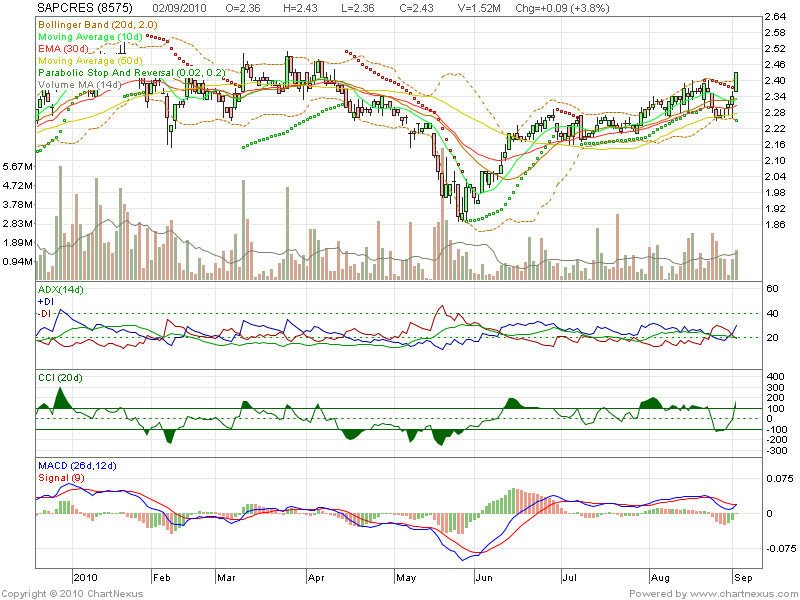
SapuraCrest: Buy, target price RM3.12

AMRESEARCH Sdn Bhd reiterated its "Buy" call on SapuraCrest Petroleum Bhd (8575)with an unchanged fair value of RM3.12 per share based on a 2010 forecast price earnings of 22 times.

The research house said the company remains the top pick in the oil and gas sector given its dominant position in Malaysia's pipe-laying/off shore installation services and tender rig market.

"SapuraCrest also has a huge order book of RM10 billion, the largest among locally listed stocks," it said.

However, including the full five-year Pan Malaysian pipe-laying contract, its gross order book is even larger at RM13 billion, with a sizeable oil and gas asset ownership.
At present, it has a substantial seadrill equity participation of 24 per cent and strong earnings forecasts from financial year 2009 to 2013 with a compound annual growth rate of 24 per cent.

"Hence, we maintain financial year 2011 forecast to financial year 2013 forecast earnings for now, which project annual earnings growth of up to 19 per cent, underpinned by the group's RM10 billion order book," it added.

AmResearch said the stock currently trades at an attractive 2010 forecast price earnings of 13 times, compared to over 25 times registered by SapuraCrest and Wah Seong back in 2007.

Read more...

Thursday, September 2, 2010

Related Posts Plugin for WordPress, Blogger...